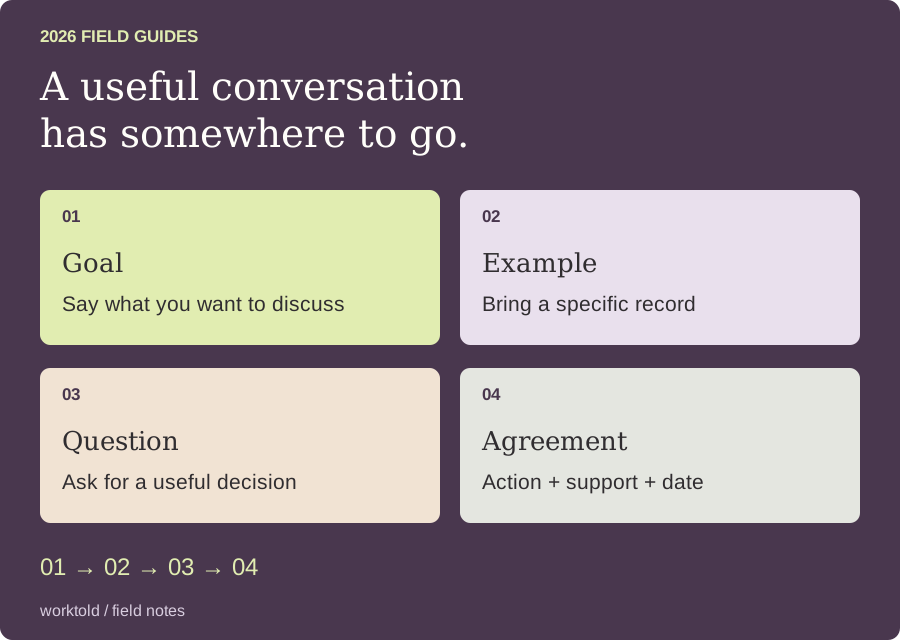
A useful career-conversation template makes the goal explicit, brings a concrete example, and asks for a decision or next step. These seven templates cover common engineering conversations in 2026: promotion readiness, project scope, vague feedback, shared credit, AI-assisted work, sponsorship, and follow-up.
The wording is a starting point. Replace the bracketed fields with facts from your work, and use the vocabulary your team uses. Do not memorize a script so tightly that you stop listening to the answer. The purpose is to reduce the effort of starting a useful discussion.
Aida’s reflection on persuasion connects communication with getting support for ideas. The same principle applies to career discussions: make the reasoning understandable, then give the other person something specific to respond to.
1. Start a promotion-readiness conversation
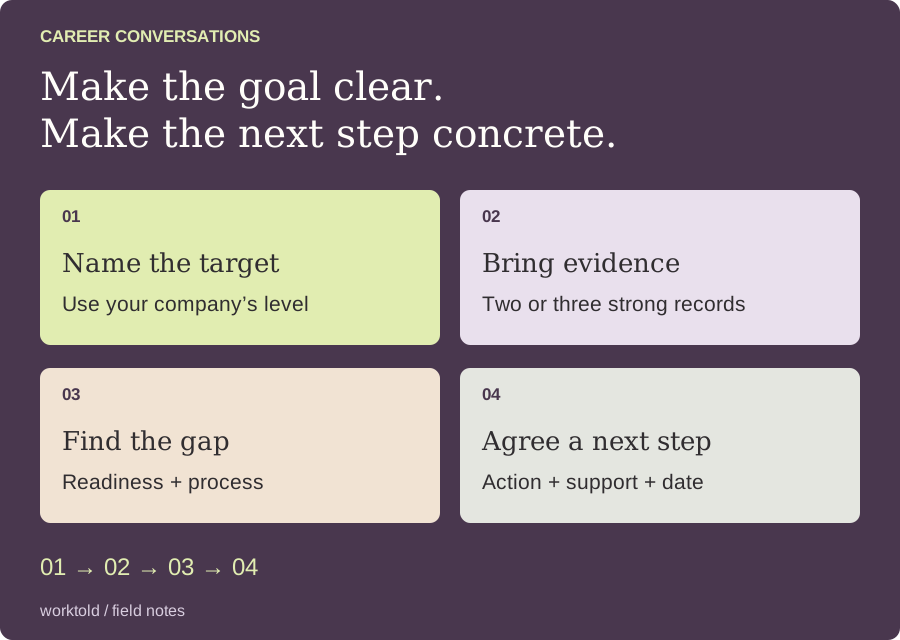
I want to work toward [level]. I have collected [two or three examples] against the framework. Which expectations do you think these support, and which need stronger evidence? I would like to agree on the next step and understand the decision process.
Bring: a few concise records and the actual criteria. Listen for: the difference between readiness and process. Leave with: a named gap or a clear submission step. If you receive general encouragement, ask what will happen next and when.
Use the promotion guide for the full preparation sequence.
2. Ask for a project that addresses a gap
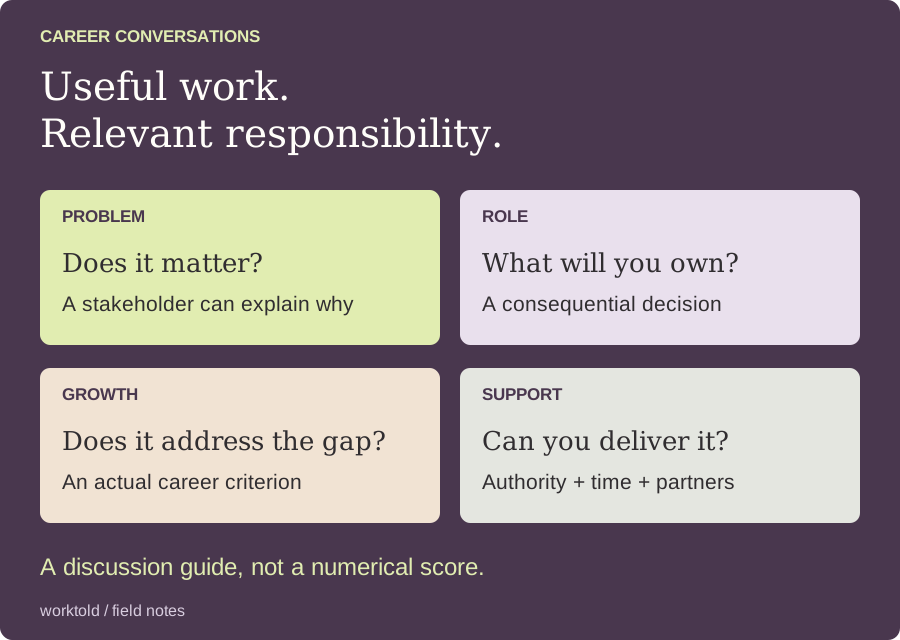
We agreed that I need stronger evidence of [specific scope]. I think [project] could provide that opportunity because [reason]. Could we define which decisions I would own, who needs to be involved, and what current work would move to make room?
Bring: the problem, your proposed role, and the dependencies. Listen for: whether the opportunity includes real authority or only extra coordination. Leave with: supported responsibility and a checkpoint.
A project title is not enough. Use the selection screen to assess whether the assignment can produce the needed evidence.
3. Clarify “be more strategic” or “not ready”
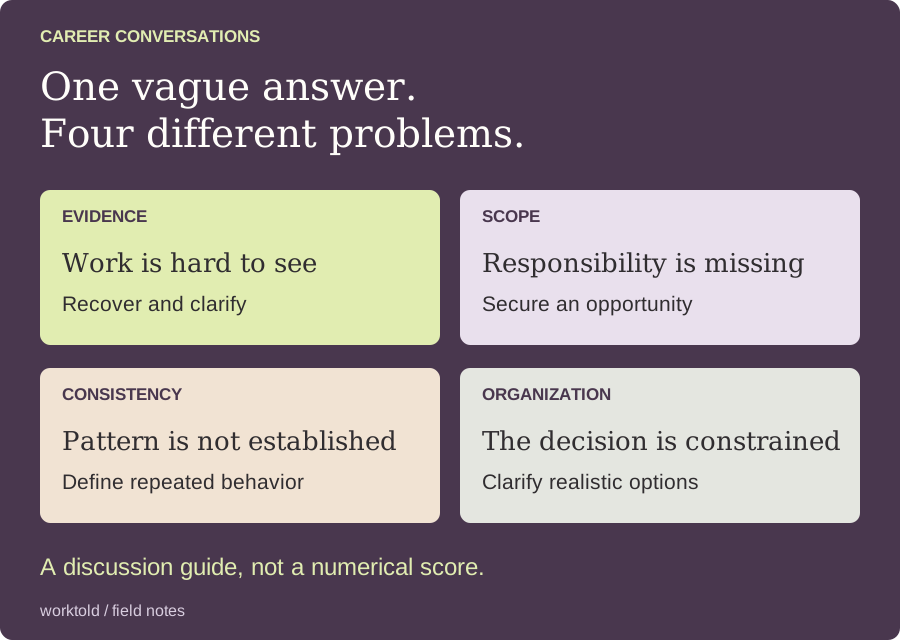
Can you give me one example of the behavior or scope you want to see? I want to understand what is different from my current work and whether the gap is in the work itself, the evidence, or the timing of the decision.
Bring: the original feedback and one recent example. Listen for: a concrete difference you can act on. Leave with: an observable behavior and the support to practice it.
If the answer remains vague, ask what a convincing example would look like. The feedback guide explains how to separate four different kinds of gap.
4. Explain your contribution to a shared result
The team achieved [result]. My responsibility was [specific role], and I made [decision or contribution]. [Colleagues] owned [their parts]. The evidence for my contribution is [source], and [outcome or uncertainty] is what we know so far.
Bring: artifacts and an accurate account of responsibilities. Listen for: whether the listener can distinguish your role from the team’s. Leave with: a clearer shared understanding, not a contest over credit.
Use precise verbs rather than automatically replacing “we” with “I.” The attribution article provides examples.
5. Discuss AI-assisted work
The assistant helped with [bounded task]. My contribution was identifying [constraint], choosing [approach], and verifying [behavior]. The evidence shows [result]. It does not yet establish [pending outcome]. Which part of this demonstrates the expectation we are discussing?
Bring: the human decision and verification evidence. Listen for: the company’s actual expectations about responsibility and AI use. Leave with: a calibrated description of the contribution.
A prompt count or generated-code volume is rarely the clearest explanation of judgment. Use the AI-work record to preserve the reasoning.
6. Ask a senior colleague for bounded support
You saw my work on [project]. My manager and I are focusing on [specific gap]. Would you be willing to review [proposal or example] and help me identify [opportunity, counterpart, or feedback]?
Bring: shared context and a request the person can honestly assess. Listen for: what they can support based on direct knowledge. Leave with: one useful action and a plan to close the loop.
Start with the support you need rather than a broad request to become your sponsor. Read the sponsorship guide for relationship and timing considerations.
7. Confirm the agreement after the meeting
My understanding is that [criterion] is supported by [example]. The remaining gap is [specific issue]. I will do [action], with [support], and we will review [evidence] on [date]. Please correct anything I misunderstood.
Bring: your notes while the conversation is fresh. Listen for: corrections before the plan hardens into an assumption. Leave with: a shared record you can revisit.
Keep the note concise and neutral. If priorities later change, update the agreement and explain why. A dated record helps distinguish a reasonable revision from an expectation that was never clear.
Use one template well
Choose the conversation you actually need now. Fill the fields with evidence, remove language that does not sound like you, and write the one question you most need answered. Practice the opening once, then focus on listening.
- State the goal directly.
- Bring a specific example.
- Ask one question that changes the next step.
- Separate facts from assumptions.
- Clarify the support you need.
- Record the agreement and revisit date.
You can keep the evidence in a plain document using the free guide. Worktold’s demo shows a dedicated journal approach. Whichever system you choose, the useful result is a clearer conversation about your next responsibility.
Written for Worktold using public sources and original illustrative examples. Product research checked November 10, 2026. Read our editorial approach and comparison limits.