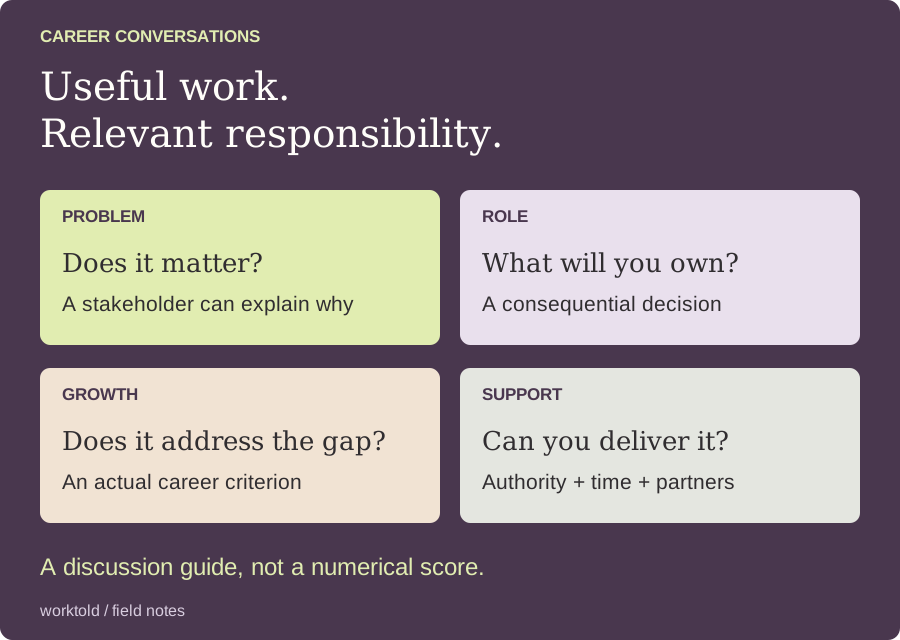
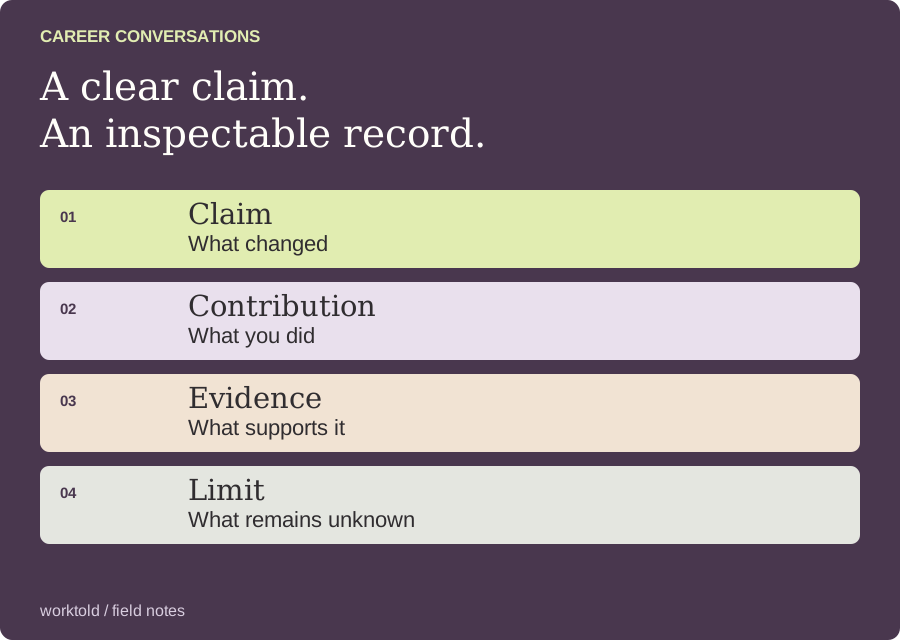
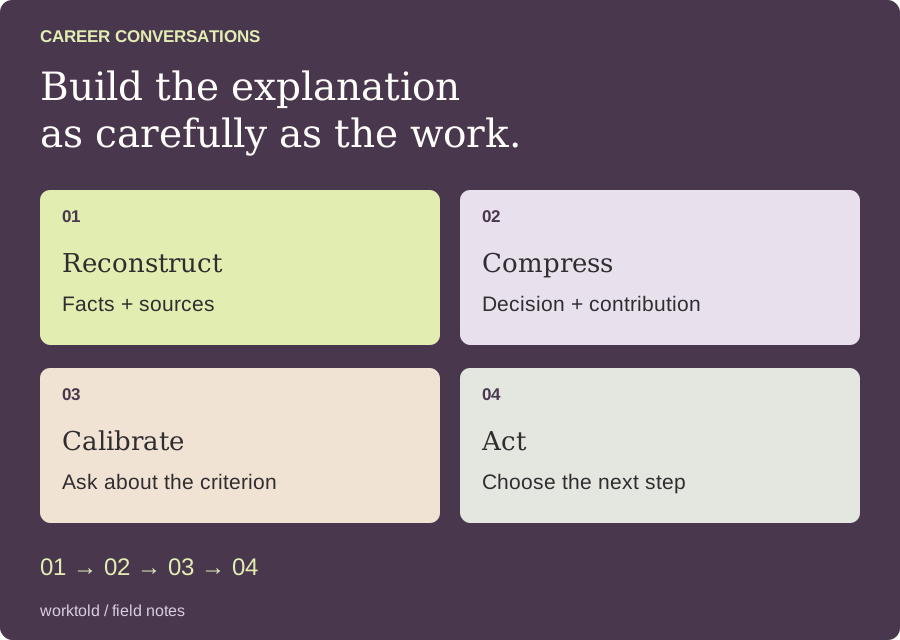
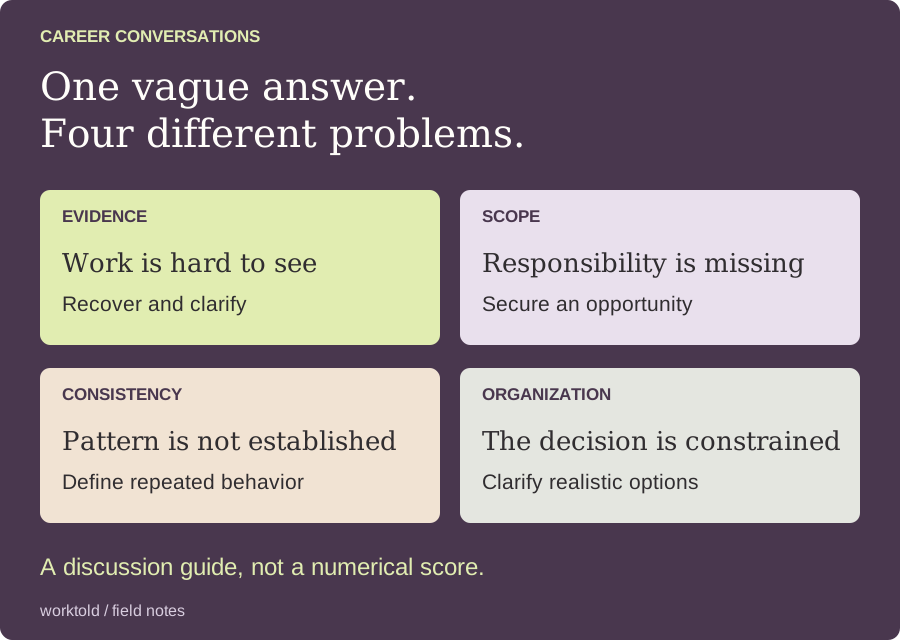
When your manager says you are “not ready,” ask which kind of gap they mean: missing evidence, missing scope, inconsistent behavior, or an organizational constraint. Each requires a different response. Leave with a concrete example, an agreed action, and a date to revisit the assessment.
Vague feedback is difficult because it sounds like a conclusion without showing the reasoning. “More strategic,” “more visible,” and “not quite there” can all mean something useful. They can also conceal several unrelated concerns. Your first task is to understand the claim before trying to fix it.
This guide offers a conversation method, not a guarantee that every promotion process is fair or predictable. If the organization cannot explain its expectations, that is information you should preserve rather than translate into an endless personal improvement project.
Find out which problem you are solving
Scroll sideways to see all columns.
| Gap | What it might mean | Next step |
|---|---|---|
| Evidence | The work happened, but reviewers cannot see or verify it | Recover sources and clarify your contribution |
| Scope | The work does not yet demonstrate the target responsibility | Agree on a suitable opportunity and support |
| Consistency | There is one strong example but no established pattern | Define the repeated behavior and review window |
| Organization | Role, timing, budget, or process blocks the decision | Clarify the constraint and realistic options |
These categories can overlap. Ask your manager to separate them anyway. Otherwise, you may spend weeks rewriting a packet when the real issue is scope, or take on more work when the real issue is a promotion freeze.
Ask for a specific example
Can you point to one expectation that is not yet supported and explain what a convincing example would look like? I would also like to understand whether the gap is in the work itself, the evidence we have, or the timing of the decision.
Then compare that example with your current work. Ask what is different: ambiguity, autonomy, number of stakeholders, duration, consequences, or influence? A concrete contrast is more useful than another adjective.
GitLab’s professional-development guidance is one public example of discussing evidence and consistent behavior. Use your company’s standards for the actual decision; borrowing another employer’s ladder does not resolve a disagreement about your own.
Turn “be more strategic” into an action
Imagine that your manager says your delivery is strong but you need to be more strategic. You ask for an example. They explain that you often arrive with a solution before the affected teams have agreed on the problem.
Now you have a behavior to practice: before the next design proposal, collect constraints from the two teams that will use the result, compare alternatives, and make the tradeoff explicit. Agree on who should review the problem framing and what evidence would show improvement.
This is very different from sending more updates or using more executive language. The work changes first. The narrative then explains the change.
Write a bounded development plan
A useful plan contains one or two gaps, the work that will address them, support from your manager, evidence to inspect, and a checkpoint. Keep it small enough to deliver alongside your actual responsibilities.
For example: “On the next compatibility initiative, I will own the problem-framing review with both client teams. My manager will help secure the counterpart and decision forum. We will review the agreed constraints, alternatives, and stakeholder feedback after the first design decision.”
This is a hypothetical plan, not a universal promotion requirement. Your manager may need a different kind of evidence. The important feature is that you can later evaluate whether the agreed work occurred and whether it addressed the original gap.
Notice when the target moves
At each checkpoint, return to the prior agreement. If the criteria change, ask why. A new business priority or clearer understanding may justify a revision. The concern is not every change; it is a pattern in which no completed action can ever count.
Keep dated notes in an approved location. Record the explanation and next step without assigning motives. If you need another perspective, ask an appropriate mentor, skip-level manager, or people partner about the process using concrete facts.
You do not need to accept an indefinite promise. If there is no available role or no path to demonstrate the required scope, ask for an honest timeline and discuss alternatives. A tool cannot resolve that organizational constraint for you.
Stay open without surrendering your judgment
Some feedback will reveal a real gap you had not seen. Some may be poorly expressed. You can acknowledge the useful part and still ask for evidence. “I understand that the cross-team decision is the missing example. I want to make sure the assignment gives me the authority to demonstrate it” is a reasonable response.
Do not measure the success of the conversation only by whether the answer becomes yes. A clear no with a specific reason gives you more usable information than vague encouragement that never changes.
- Identify the type of gap.
- Ask for one concrete example of sufficient evidence.
- Compare it with your current work.
- Agree on a bounded action and needed support.
- Record a checkpoint.
- Revisit the same criteria and clarify any change.
Use the project-selection screen when scope is missing. Use the self-review guide when the evidence is hard to see. The manual evidence guide can support either conversation without waiting for a new product.
Written for Worktold using public sources and original illustrative examples. Product research checked November 10, 2026. Read our editorial approach and comparison limits.