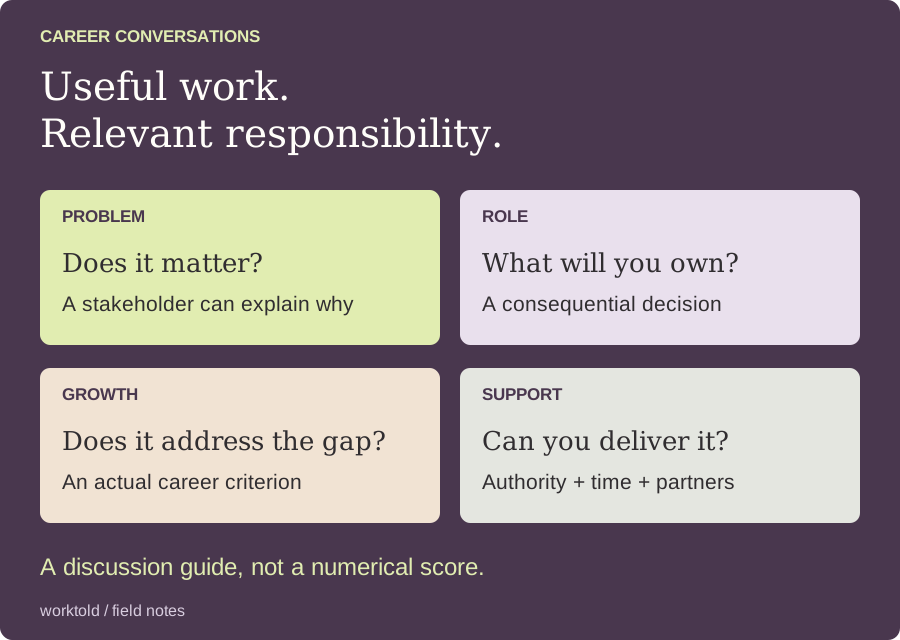
Ask for a promotion by making your target explicit, bringing a small set of evidence, and asking your manager to evaluate the gaps and process with you. Leave with an agreed next action and a date to revisit it. A clear conversation is more useful than waiting for your work to be noticed or presenting an ultimatum before you understand the constraints.
The hardest part is often the opening sentence. Engineers who can defend a design under pressure may hesitate to say they want more responsibility. The request can feel personal because the work matters to you. You do not need to disguise the goal as a hypothetical discussion.
Aida’s promotion-mistakes article recommends initiating the conversation. The approach here gives that conversation a structure without assuming a universal promotion process.
Prepare three things before the meeting
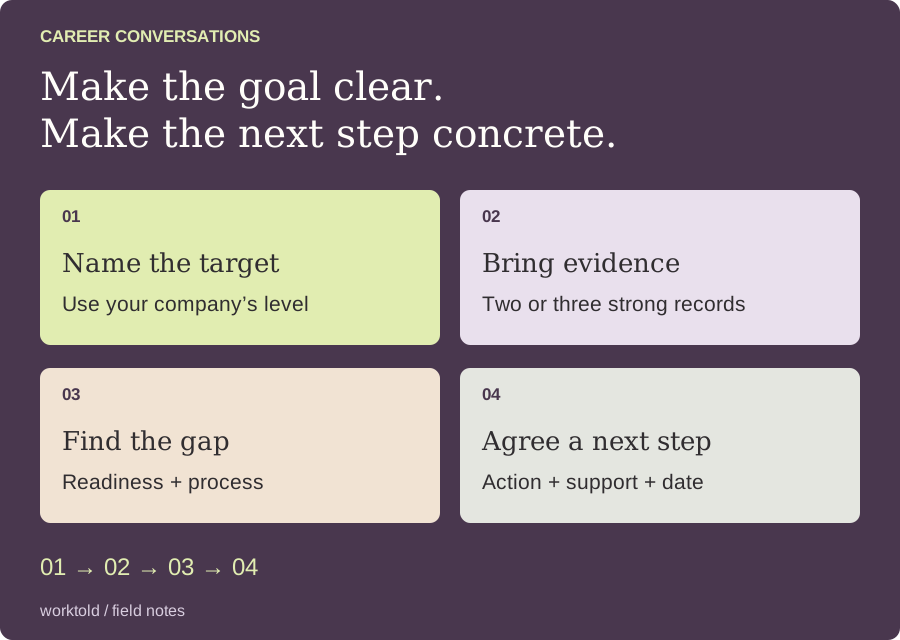
First, identify the target role or level using your company’s language. “I want to grow” is a reasonable intention, but it is too broad to calibrate. Ask which framework and process apply if you do not know.
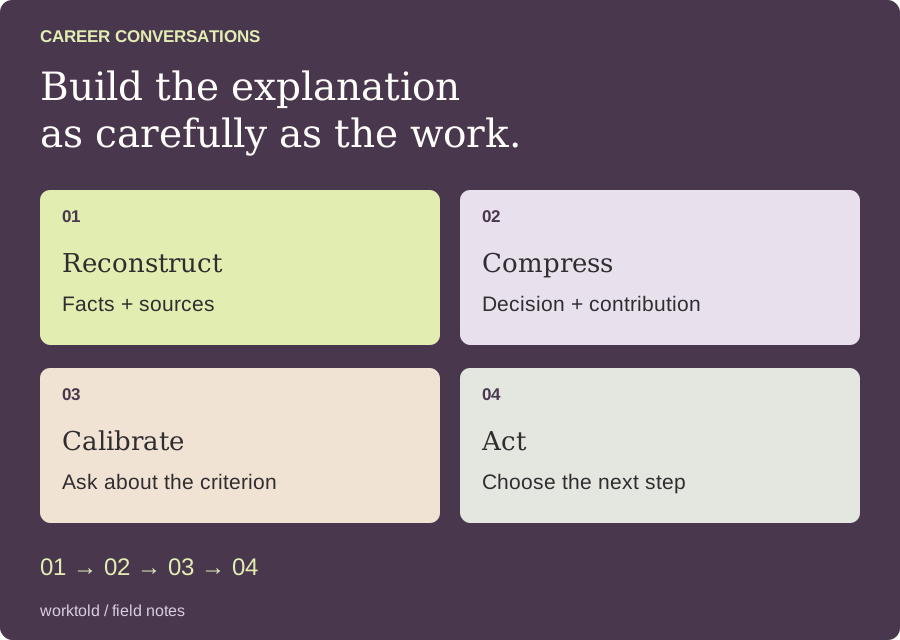
Second, select two or three records that show relevant scope. For each, include the situation, your decision, your contribution, and the result. Do not bring a hundred-item activity log and ask your manager to discover the case.
Third, write your uncertainties. Perhaps your impact is clear but your cross-team influence is not. Perhaps you have one strong example but do not know what consistency means at your company. Naming those questions makes the discussion more productive.
Use a direct opening
I want to work toward promotion to [level]. I have collected a few examples against the framework, and I would like your assessment of where the evidence is strong and what is missing. Can we use this meeting to agree on the next steps and understand the decision process?
This is a reusable script, not a statement about your readiness. Replace the bracketed level and bring the evidence. If the meeting is too short, use the opening to schedule a dedicated discussion rather than squeezing the topic into the last two minutes.
Separate readiness, process, and opportunity
Scroll sideways to see all columns.
| Topic | Question | Useful output |
|---|---|---|
| Readiness | Which criteria are supported, and which need stronger evidence? | A named gap with an example |
| Consistency | What pattern over time would demonstrate this expectation? | An observable standard, not an invented universal duration |
| Process | Who decides, what material is required, and when is it considered? | The actual decision path |
| Opportunity | What upcoming work would let me demonstrate the missing scope? | A viable assignment and needed support |
| Follow-up | When will we review the new evidence? | A date and shared record |
For an example of an organization making this process explicit, GitLab’s professional-development guidance discusses goals, evidence, and consistent behavior. It is a useful reference, not your employer’s policy.
Respond to the answer you actually receive
If your manager says the case is strong, ask what happens next. Who writes the document? Which reviewers need context? Is there a submission date? Agreement in a one-on-one is encouraging, but it is not the same as a completed promotion decision.
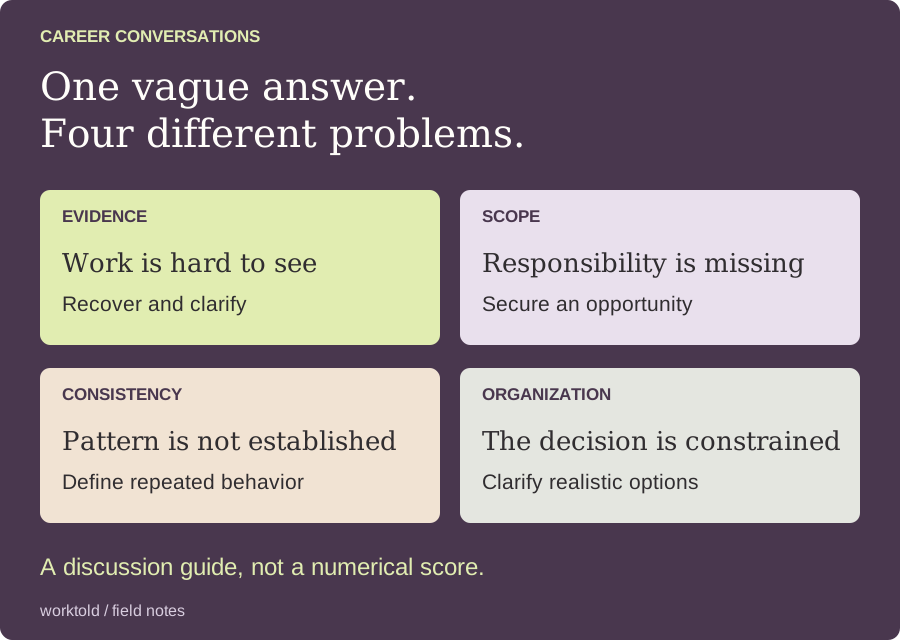
If the answer is “not yet,” ask for the specific gap and an example of sufficient evidence. “More leadership” is too vague to plan around. “Lead the rollout decision across both client teams, including their constraints” gives you something to discuss and scope.
If the answer is about budget or role availability, clarify whether your readiness assessment is separate. You may need a timeline, a different opportunity, or a candid discussion about what the organization can offer. Rewriting your packet repeatedly will not create a role that does not exist.
Write a short follow-up record
After the meeting, capture the target, supported criteria, open gaps, planned work, and next review date. Use neutral language. The purpose is shared understanding, not building a case against your manager.
My understanding is that [criterion] has strong evidence from [example]. The remaining gap is [specific scope]. I will take [action], with [support] from you, and we will review [evidence] on [date]. Please correct anything I misunderstood.
Keep the follow-up in an approved shared location if that fits your team’s practice. At the next meeting, compare new evidence with the agreed gap. If the expectation changes, ask what changed and update the record. Do not silently keep working toward an obsolete standard.
Avoid three traps
Arguing from effort alone. Long hours may explain the cost of the work, but they do not establish the target level. Describe judgment, scope, and results instead.
Comparing yourself with a colleague. You may not know their full case. Use your company’s criteria and your own evidence so the discussion remains assessable.
Taking on unbounded extra work. If demonstrating scope requires a new project, discuss priorities and support. A promotion plan that depends on indefinitely doing two jobs may be neither realistic nor healthy.
- Name the target clearly.
- Bring a few strong, sourced examples.
- Ask about both readiness and process.
- Turn vague feedback into an observable gap.
- Agree on supported work, not unlimited extra effort.
- Record the next action and revisit date.
Use the “not ready” guide if the feedback stays vague, and the project-selection guide when you need a better opportunity. Worktold’s demo shows one way to organize the evidence; the conversation and calibration remain human decisions.
Written for Worktold using public sources and original illustrative examples. Product research checked November 10, 2026. Read our editorial approach and comparison limits.