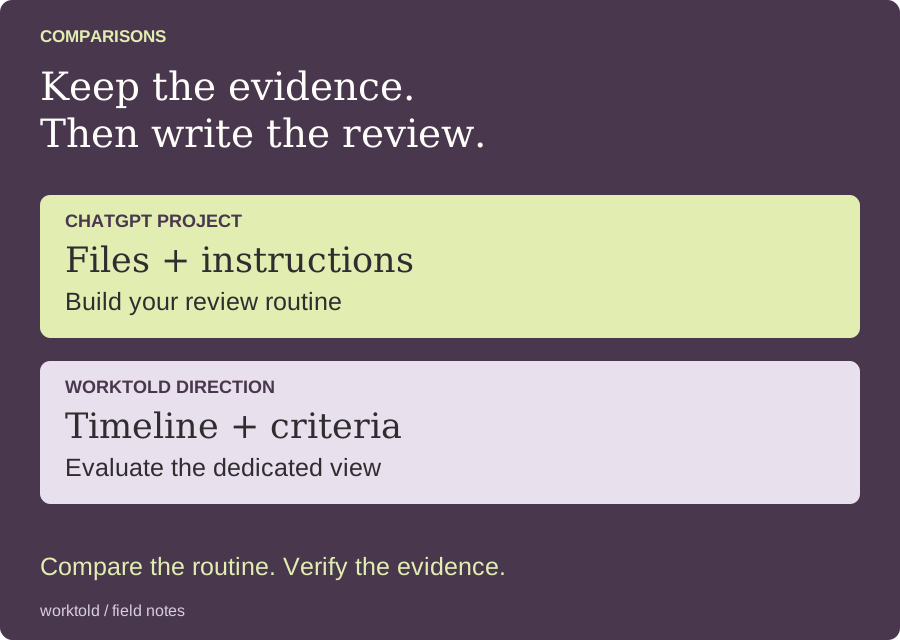
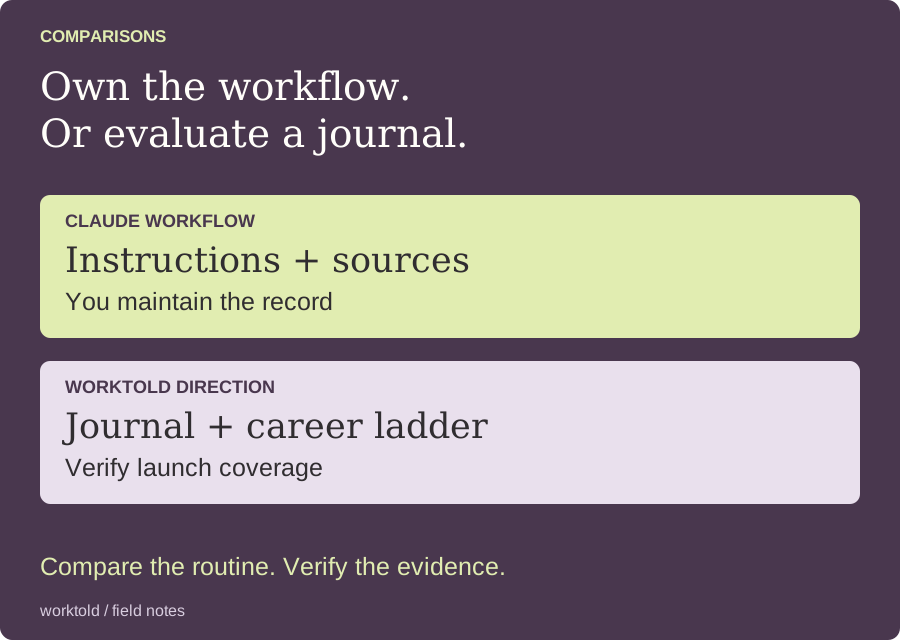
A manual brag document is a strong default if you can keep a short weekly habit. It gives you direct control over what you record and where you store it. Worktold is designed to reduce the recurring work of connecting context and organizing evidence against a career ladder. Whether that saves you effort should be tested when the product is available.
There is nothing unsophisticated about a text file, spreadsheet, or Google Doc. A precise record in a plain document is more useful than a beautiful dashboard full of vague accomplishments. The comparison starts with your actual failure point: forgetting to capture, struggling to explain impact, losing source context, or being unsure what your manager expects.
This article reflects the product state on November 10, 2026. We publish Worktold. Its public site currently offers a fictional-data demo and free guide, with MVP early access planned for November 26–29. The manual method below can be used today.
Manual does not have to mean unstructured
Julia Evans’s brag document essay makes a durable case for recording work that you and your manager may otherwise forget. The document can also help you reflect on the work you want to do next. The format is less important than making the information recoverable.
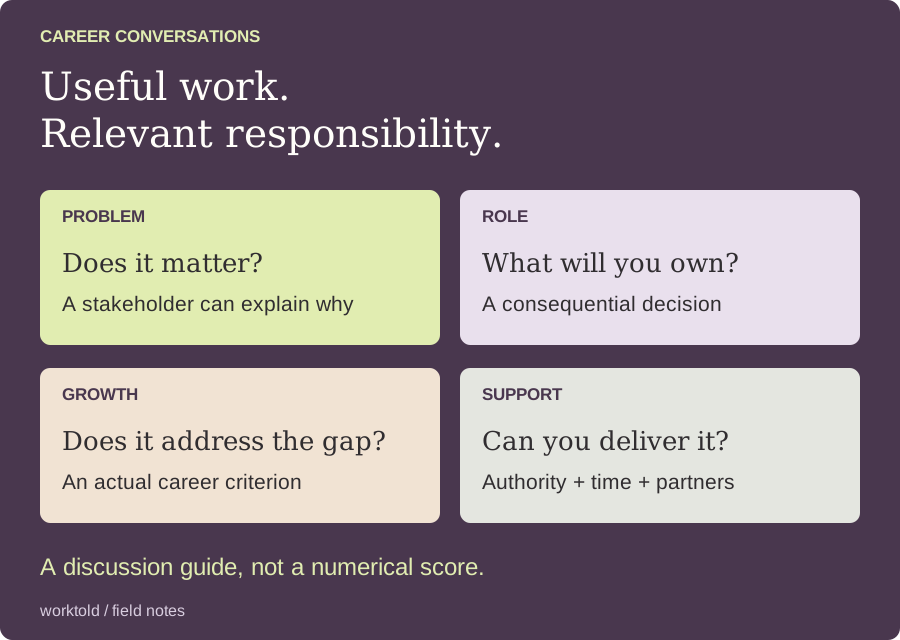
For each meaningful contribution, capture the problem, your decision, your role, and the result. Add the date, source, and relevant career expectation. If a result has not arrived, say what is pending and when you will check. This prevents a journal from becoming a list of promises that quietly turn into achievements at review time.
Compare effort at each stage
Scroll sideways to see all columns.
| Stage | Manual record | Worktold |
|---|---|---|
| Collect | You choose and add relevant evidence | Selected cross-tool context is the intended starting point; verify supported sources |
| Explain | You write the decision and contribution | The described workflow proposes records for your review |
| Map | You connect records to your ladder | The demo shows evidence organized by career criteria |
| Correct | You edit the document and maintain history as needed | Human verification remains necessary |
| Keep access | Depends on where the document lives and applicable permissions | Personal-email continuity is in the founder’s brief; released behavior is not verified |
| Start now | Use an approved document or local file | Explore the demo and free guide while awaiting the MVP |
A weekly routine small enough to keep
Choose a recurring moment after a weekly review or before your manager meeting. Look at work that changed a decision, removed a constraint, helped another person deliver, or produced a measurable result. Do not copy every ticket. A journal that takes longer to maintain than the work it explains is unlikely to survive a busy month.
Write one entry in rough language before editing it. For example: “The rollout plan had no check for old app versions. I raised the risk, added a compatibility test with Priya, and we found a failing path in staging. The team changed the release gate. Production outcome pending.” Attach the test and decision record if permitted.
Then add a possible criterion: technical judgment. Write “candidate evidence” if you are unsure how the company interprets it. At the next career conversation, ask whether the example demonstrates the expected scope. If it does not, you have learned something while there is still time to change the work.
Diagnose why the document goes stale
If you forget to open it, use a smaller routine and an existing reminder. If the blank page is the problem, use the same four questions each time. If you cannot remember the details, capture a one-sentence note when the decision happens and expand it later. None of those problems automatically requires a new product.
A more persistent difficulty is scattered context. A pull request may show the implementation but not the design debate. A chat may show your correction but not the later result. A document may contain the result but obscure your role. Reassembling that chain repeatedly is the work Worktold is intended to help with.
Before buying anything, count the burden honestly. Over two weeks, record how long you spend finding sources, writing entries, and preparing a summary. Do not use invented industry averages. Your own routine gives you a baseline for evaluating whether another system is worth the setup, cost, and permissions.
Keep a useful document if you later switch
You do not need to abandon the record you already have. Preserve a dated copy in an approved location and keep stable source references. Identify which fields you would want in any new system: date, project, contribution, outcome, confidence, criterion, and follow-up. Test a few representative entries before attempting a full move.
This is a migration checklist, not a claim that Worktold supports a particular import format. Confirm import, export, attachment handling, and correction behavior directly before depending on them. A personal account also does not make employer-owned artifacts yours to retain after leaving. Plan for permitted summaries and account access separately.
Choose the lowest-maintenance system that works
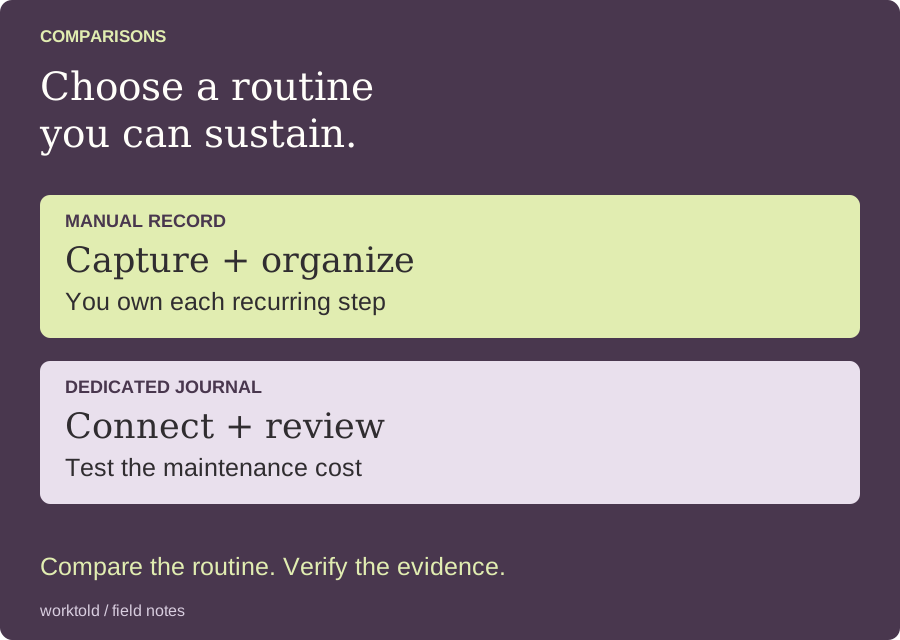
Keep the manual method if it already helps you arrive at career conversations with accurate examples. You have no obligation to replace a working habit. Consider a dedicated product if the recurring collection and organization cost keeps breaking that habit, and the product demonstrably covers the sources and records you need.
Do not judge the choice by the number of entries. Three records that changed your next project discussion may be more useful than a hundred activity notes. The outcome is a clearer decision with your manager: what is supported, what is missing, and what work should come next.
- Write one record from this week.
- Check each factual claim against a source.
- Mark unknown outcomes explicitly.
- Ask your manager about one candidate ladder mapping.
- Review the maintenance cost after two weeks.
- Keep or change the system based on that evidence.
Start with The Promotion Packet, by Hand, then read how to choose projects that build relevant evidence. If your main need is drafting, the ChatGPT comparison may be more useful than adding another tracking tool.
Written for Worktold using public sources and original illustrative examples. Product research checked November 10, 2026. Read our editorial approach and comparison limits.