Choose a growth project by identifying a company problem that matters, the judgment you would own, and the evidence it could produce for your target-level expectations. A project’s visibility or technical difficulty alone does not make it a good promotion opportunity. Check whether you can actually influence the outcome and obtain the support to deliver it.
You can spend a quarter doing demanding work and still finish with little evidence for the gap your manager identified. The work may be valuable. It may simply demonstrate a strength you already have rather than the scope you need to develop.
Aida’s promotion-mistakes article emphasizes choosing meaningful projects and demonstrating the next level. Apply that principle through your own company’s framework. There is no universal project size or fixed number of months that proves readiness everywhere.
Start with a named gap
Ask your manager which expectation needs stronger evidence. “More leadership” is not specific enough. “Influence a technical decision involving two teams with conflicting constraints” is a useful starting point. The distinction changes which opportunities you should consider.
Write down one strong example you already have and what it does not prove. Perhaps you repeatedly deliver within your team, but there is little evidence of helping other teams make decisions. Another difficult solo implementation may not address that gap.
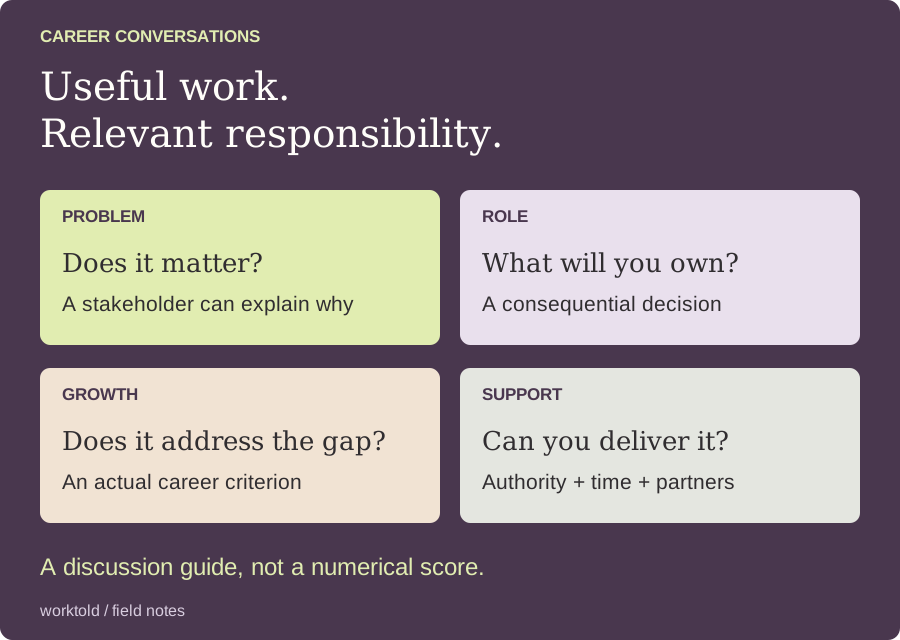
Screen projects with five questions
Scroll sideways to see all columns.
| Question | Evidence to seek before committing |
|---|---|
| Does the problem matter? | A stakeholder can explain the consequence of leaving it unresolved |
| What judgment will I own? | A real decision, constraint, or tradeoff within your remit |
| Does it address my gap? | A plausible link to the exact expectation under discussion |
| Can I deliver it? | Time, access, collaborators, and decision authority |
| How will we observe the result? | An artifact, adoption signal, operational measure, or other agreed evidence |
Use the questions as a conversation aid, not a numerical promotion score. A project with a strong business need but no authority to resolve dependencies may require a sponsor. A project with excellent learning value but little relevance to the current gap may still be worth doing, provided you are honest about the tradeoff.
Compare two fictional opportunities
Opportunity A is a technically complex rewrite inside your own service. You would control the implementation and learn a great deal. Opportunity B is a smaller compatibility change requiring agreement between platform and client teams. You would clarify conflicting constraints, coordinate the release plan, and document the decision.
If your gap is technical depth, A may be the stronger choice. If the gap is influence across teams, B may provide more relevant evidence. Neither is inherently “senior” or “staff” work without the company context. The important question is which responsibility you would actually carry.
Now add feasibility. If B has no available client-team partner and no agreed owner, it may become an endless coordination exercise. Before accepting it, ask for a named counterpart, a decision forum, and an escalation path. Career growth should not depend on quietly absorbing an organizational problem without support.
Agree on the learning and delivery contract
Write a short project note with your manager: the problem, your responsibility, collaborators, constraints, intended result, and what evidence would demonstrate the target expectation. Include what work will be deprioritized. A plan that only adds responsibility to a full workload is not a credible plan.
Also state what success could look like if the original approach is wrong. A well-run investigation may conclude that the project should stop. If that decision is supported and useful, it can still demonstrate judgment. Do not build a career plan that rewards shipping a weak solution just to produce a launch story.
Choose an early checkpoint. Review whether the assignment is actually giving you the promised scope. If all consequential decisions remain elsewhere, say so while there is still time to change your role.
Capture the work as it happens
Keep short records at decision points: what alternatives were considered, which constraint changed the plan, how you resolved disagreement, and who used the result. Add delivery and outcome evidence later. This makes the eventual narrative easier to write and exposes gaps before review season.
For example, “coordinated three teams” is difficult to assess. “Brought the client compatibility constraint into the API review and secured agreement on a staged rollout” explains a contribution. Attach the decision record and describe the other participants’ roles fairly.
Do not map every activity to the target level. Keep useful work that falls outside the promotion case. A complete work history and a selected promotion narrative serve different purposes.
Reassess when the context changes
A business priority may disappear, another person may take ownership, or the project may lose its expected users. Revisit the original reasoning instead of continuing solely because the project was once called a growth opportunity. Ask whether the work still matters and whether your role still addresses the agreed gap.
If the organization cannot offer the needed scope, name that limitation. More documentation will not create an opportunity. You and your manager may need to consider a different assignment, a longer timeline, or a different role.
- Name the exact evidence gap.
- Choose a real problem with a stakeholder.
- Clarify your decision responsibility.
- Secure collaborators and authority.
- Agree what existing work will move.
- Define an early checkpoint and observable result.
Bring the screen to your next promotion discussion. If you need someone to help secure scope, read the sponsorship guide. Worktold’s ladder demo illustrates how evidence can reveal a gap; choosing the next project requires judgment and agreement.
Written for Worktold using public sources and original illustrative examples. Product research checked November 10, 2026. Read our editorial approach and comparison limits.