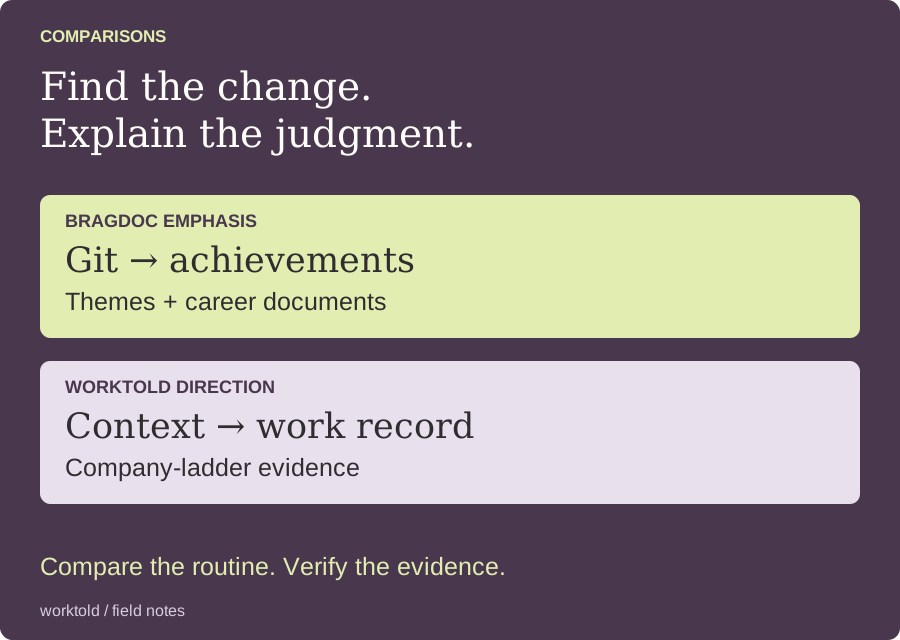
BragDoc is worth evaluating when Git history is the strongest starting point for your career record. Worktold is intended to connect work across conversations, documents, AI sessions, and saved artifacts, then relate that evidence to a company ladder. The useful distinction is the evidence you need to recover, not a claim that one product automatically creates a stronger promotion case.
If review season arrives and you cannot remember what you shipped, Git-derived achievements can be a practical starting point. If you remember the shipped change but have lost the reasoning, disagreement, or investigation behind it, you have a different retrieval problem. An engineer may need both kinds of evidence.
We publish Worktold. This is a public-documentation comparison checked November 10, 2026, not a hands-on product benchmark. Worktold currently has a demo and free guide; MVP early access is planned for November 26–29. We do not treat demo behavior as proof of shipped integrations.
What BragDoc documents
BragDoc’s site describes extracting achievements from Git history and producing career documentation. Its CLI documentation describes reading Git metadata and choosing an LLM provider. Its Workstreams announcement describes grouping achievements into themes. These are substantial capabilities; calling BragDoc a simple commit counter would be inaccurate.
Public descriptions establish what the vendor says the product does. They do not establish whether a particular extraction is complete, whether a theme matches your company’s expectations, or whether an inferred outcome is correct. Those are questions for a trial using your own approved evidence.
Compare the evidence path
Scroll sideways to see all columns.
| Dimension | BragDoc | Worktold |
|---|---|---|
| Documented emphasis | Git-derived achievements, themes, and career documents | Cross-tool work records and company-ladder evidence |
| Collection to inspect | CLI extraction from the repositories you configure | Selected sources in the intended workflow; launch coverage requires confirmation |
| Organizing principle | Achievements and Workstreams | Timeline and career criteria shown in the demo |
| Human responsibility | Check whether extracted statements match what happened | Check sources, attribution, completion state, and mappings |
| Best evaluation case | A project with useful Git history | A contribution whose reasoning spans multiple tools |
Test a migration, not a marketing example
Consider a fictional API migration with twelve pull requests. You authored four, reviewed three, and coordinated a compatibility decision that changed the rollout plan. Two colleagues implemented the remaining work. The migration reached staging, but the production rollout has not happened.
Start by asking what the repository proves. It may establish authorship, review participation, and merge state. It may contain detailed explanations of tradeoffs. It may also have terse commit messages that omit the most important conversation. Inspect the actual record rather than assuming Git is always rich or always insufficient.
Then inspect the decision evidence. Where is the compatibility concern documented? Who proposed the alternative? Who agreed to change the rollout? Which artifact demonstrates the result? The same investigation can reveal whether your current problem is extraction, organization, or missing evidence that no tool can recover.
Four checks for any generated achievement
Attribution: Does the summary distinguish authoring a change from reviewing it or coordinating its rollout? A useful record can recognize several people without assigning the entire project to each one.
Completion: Does it say merged, staged, deployed, or measured? Those are different facts. If the only source is a merged pull request, production success remains unproven.
Outcome: Does a business claim have an independent source? A commit message saying “improve retention” is an intention unless measured retention data supports the result.
Scope: Does the record support the particular ladder criterion you are discussing? A technically difficult change may show depth without proving influence across teams. Add the missing evidence or keep the narrower claim.
Review the actual data path
The BragDoc CLI documentation describes local processing of Git metadata and sending achievement summaries to its web app. It also describes configurable LLM providers. Inspect the provider and data flow you configure rather than translating “local CLI” into a blanket assumption that nothing ever leaves your computer.
Apply the same standard to Worktold. The product brief describes selected context from work tools and a journal that can remain linked to a personal email. Exact connector coverage, retention, export, and post-employment behavior are not verified by the landing-page code. Ask for those details before relying on the product for sensitive work.
When each direction fits
Evaluate BragDoc first if reconstructing repository activity is your main recurring burden and its documented workflow fits your environment. You may be able to build a useful career record around that starting point and add non-code context yourself.
Evaluate Worktold’s intended workflow if you repeatedly lose the contribution between a discussion and an artifact: a constraint discovered, a flawed AI suggestion corrected, or an investigation that changed a plan without producing a merge. The demo can help you judge the record format. A trial after release must establish whether it handles your real sources well enough.
- Choose one project with shared ownership.
- Prepare approved source evidence before comparing outputs.
- Check attribution and completion state line by line.
- Find one important contribution missing from the first draft.
- Correct it and inspect the resulting document.
- Compare the time needed to maintain a trustworthy record.
For another Git-centered option, see Worktold vs Pull Tally. For the larger decision, use our 2026 brag-document tools guide. If you already have the evidence, start with writing the self-review instead.
Written for Worktold using public sources and original illustrative examples. Product research checked November 10, 2026. Read our editorial approach and comparison limits.