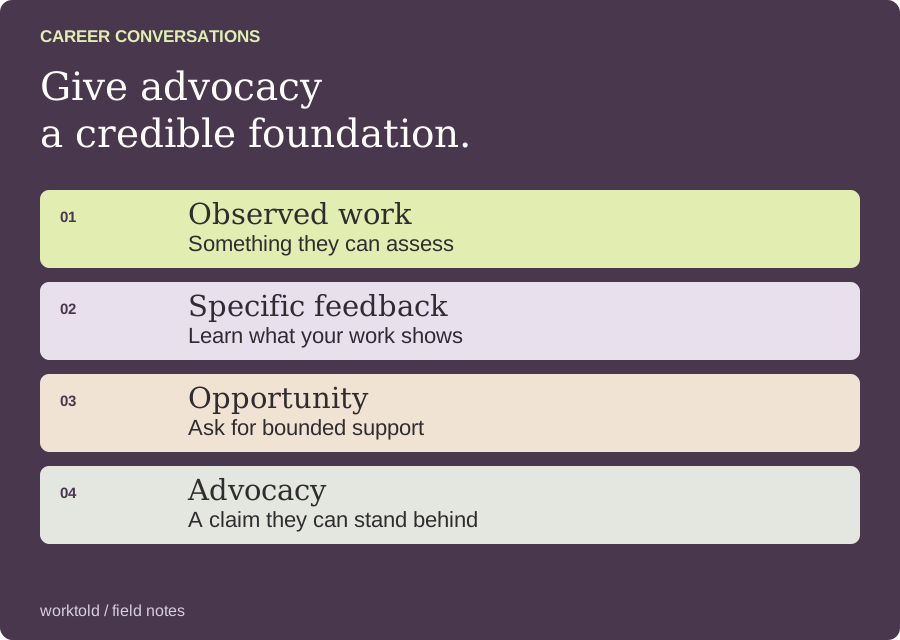
Build a sponsorship relationship by doing useful work that a senior colleague can observe, asking for specific feedback, and making a concrete request for opportunity or advocacy. A sponsor needs a credible basis to support you. Start with shared work and evidence rather than asking a stranger to “be your sponsor.”
A mentor may help you think through a difficult choice. A sponsor may use their influence to help you get an opportunity or make sure your contribution is understood in a decision. One person can play both roles, and organizations use these terms differently. Clarify the actual support you need.
Aida’s promotion advice includes finding an advocate beyond the immediate manager. This guide turns that idea into a practical approach without treating sponsorship as a shortcut around doing the work.
Name the help you need
“I need a sponsor” is too broad to act on. You might need access to a cross-team project, feedback on whether your work demonstrates the target scope, an introduction to a stakeholder, or someone who can explain your contribution during calibration.
Write the request in terms of that concrete need. For example: “I want to demonstrate cross-team design leadership. Could you help me identify an upcoming problem where I can own the decision process?” This gives the other person something to evaluate and keeps the conversation connected to useful work.
Start where your work is visible
Look for a senior colleague who has observed your judgment or depends on the outcomes you help produce. They may have reviewed a design, worked with you during an incident, or seen another team adopt your work. Their ability to advocate is stronger when it rests on direct knowledge.
A person with a high title but no exposure to your work may be able to offer advice, but they cannot responsibly make detailed claims about your performance. Begin by seeking feedback or a bounded opportunity. Do not ask them to endorse a case they have not had a chance to assess.
Make a request appropriate to the relationship
Scroll sideways to see all columns.
| Relationship | Useful request | What to bring |
|---|---|---|
| They know the problem, not your work | Feedback on where you could contribute | A short explanation of your interests and relevant experience |
| They observed one project | Feedback on your specific contribution | A concise record and a question about scope |
| They have seen a pattern | Help securing a relevant opportunity | The gap you are addressing and a realistic proposal |
| They can assess your readiness | Specific advocacy in the appropriate process | An accurate, sourced case and the decision context |
These are suggested stages, not a mandatory sequence. The underlying principle is to ask for support that the person can provide honestly.
A fictional request that is easy to assess
You reviewed the client-compatibility work I led last quarter. My manager and I agree that I need more evidence of coordinating decisions across teams. I am considering the authentication migration because it has the same kind of conflicting constraints. Would you be willing to review my proposed role and help me identify the right counterpart on the platform team?
The request names shared context, a defined gap, a possible opportunity, and a bounded action. It does not demand a promise of promotion. The person can agree, suggest a better project, or explain why the opportunity is unsuitable.
If they help, close the loop. Explain what you learned, what decision changed, and what happened next. This makes the relationship useful and gives them direct evidence of how you act on feedback.
Keep your manager in the conversation
Where appropriate, discuss the relationship and opportunity with your manager. A sponsor can broaden your access and perspective; your manager often controls priorities, staffing, and the formal review process. Conflicting promises from different people can create work you cannot realistically deliver.
Ask for alignment on your responsibility and available time. If the new opportunity addresses an agreed development gap, decide what other work will move. A prestigious assignment without capacity or authority can become an obstacle rather than a growth opportunity.
Make advocacy easy to do accurately
When the time comes for a promotion or role discussion, provide a short record of the contribution the person actually observed. Include the problem, your role, the result, and the relevant expectation. Ask whether the description matches their experience.
Do not draft praise for someone to sign without review or pressure them to make claims outside their knowledge. A narrower endorsement grounded in direct observation is more credible than a broad statement of excellence.
If they disagree with your interpretation, ask what they saw differently. That information may improve your case or reveal a gap to address. Sponsorship should not require pretending there is no uncertainty.
If sponsorship is hard to access
Some engineers have fewer opportunities to work with influential colleagues. Start by making useful work discoverable through the channels your organization already uses: design reviews, incident learning, cross-team documentation, or a shared technical forum. Ask your manager to help you access work where the needed scope is visible.
You cannot guarantee that a senior person will advocate for you. You can improve the conditions for a credible relationship: useful contribution, reliable follow-through, clear requests, and accurate evidence. If access remains blocked, discuss that as an organizational constraint rather than assuming it reflects your ability.
- Name the support you need.
- Choose someone with relevant context.
- Bring one concise, verifiable example.
- Make a bounded request.
- Align priorities with your manager.
- Close the loop and invite corrections.
Prepare with the project-selection guide and the attribution guide. Keep the source record in a system you can maintain—our manual guide is a practical starting point.
Written for Worktold using public sources and original illustrative examples. Product research checked November 10, 2026. Read our editorial approach and comparison limits.