A Claude skill can be a good way to turn approved work evidence into a career record. Choose that route if you want to own the instructions, files, and review routine. Worktold is being built around a dedicated journal and your company’s career ladder. Its live demo shows that workflow; the product is still in early access planning.
The important comparison is not which tool can write a more impressive paragraph. It is which system helps you explain a decision six months later: what you knew, what you changed, what you personally contributed, and what actually happened. A polished sentence without that chain is still an unsupported claim.
This is a documentation-based comparison, reviewed November 10, 2026. We publish Worktold, so we have a commercial interest. We have not run a controlled product benchmark. Examples below are constructed evaluation exercises, not customer results.
What a Claude skill can do
Anthropic describes skills as reusable knowledge and workflows, including custom skills. Claude also has connectors for retrieving information from connected services. This means a fair comparison must include a configured Claude workflow, not assume that Claude only sees the text you paste into one conversation. Availability and permissions depend on the environment you use. See Anthropic’s skills documentation and connector documentation.
You can define a record format, provide your career framework, and ask Claude to identify evidence and missing information. The format should live somewhere you can inspect and maintain. Giving a model a ladder does not establish that every mapping it produces is correct; a human still needs to assess the scope and strength of the evidence.
Compare the work you would own
Scroll sideways to see all columns.
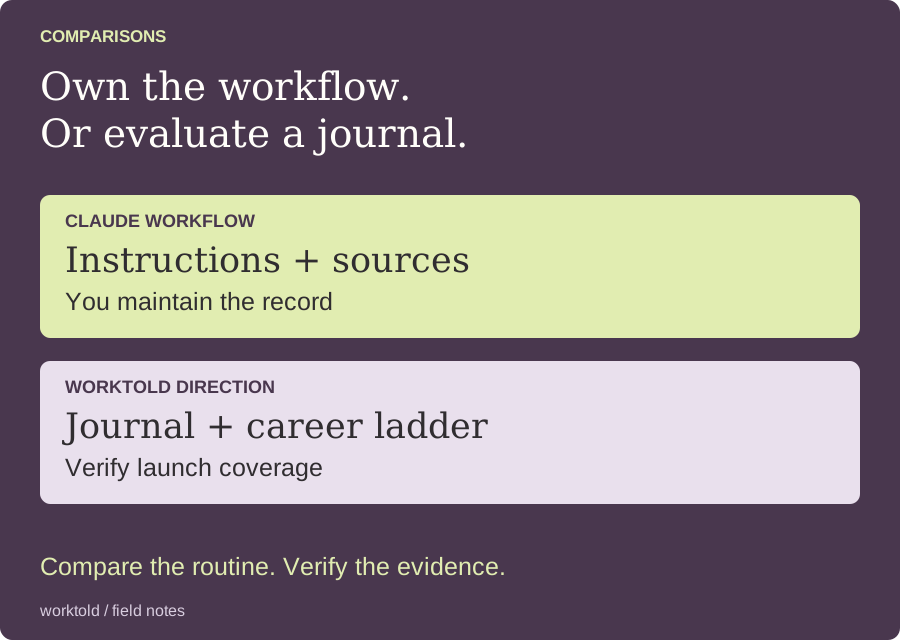
| Decision | Claude with a custom workflow | Worktold |
|---|---|---|
| Starting point | Your instructions, approved sources, and chosen record format | A dedicated work journal and ladder workflow shown in the demo |
| Capture routine | You define what to retrieve, when to run, and where to save it | Selected cross-tool context is part of the intended product; confirm launch coverage |
| Ladder mapping | You provide criteria and review the proposed mapping | The demo organizes evidence against sample criteria; use your actual framework |
| Corrections | You design how corrected facts replace earlier drafts | Reviewing and correcting suggested records is part of the described workflow |
| Best reason to choose | You want a flexible system you can maintain yourself | You want to evaluate a purpose-built journal as it becomes available |
Use the same investigation to evaluate both
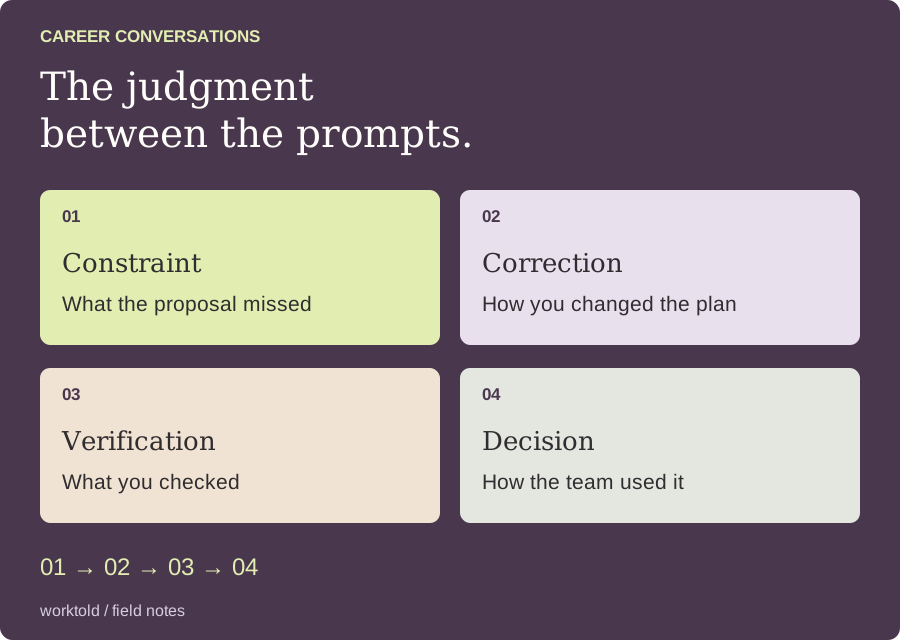
Imagine a proposed database change. A design comment asks whether a user will immediately see an updated status. A team discussion reveals replica lag. An AI session suggests a cache change, but you notice that bypassing the cache still reads from the replica. You run a small experiment and document that the proposal does not meet the requirement.
There is no production launch in this example. There may be a valuable contribution: you identified a missing constraint, tested it, and gave the team an answer. The record should support those claims and stop there. “Prevented a major outage” requires evidence the example does not provide.
Give either workflow the same approved source bundle. Ask it to produce a record and identify what remains unknown. Then inspect the result against the original material. A useful output distinguishes your correction from the assistant’s suggestion and the experiment’s result from a business outcome.
An existing skill you can inspect
Worktold already offers a free companion skill through The Promotion Packet, by Hand. The supplied instructions cover Claude Code and Codex session files: identify candidate decisions, ask the person to confirm them, and write short local records. It is a useful concrete alternative to waiting for the product.
The skill’s own instructions exclude maintaining a continuous journal, quarter-wide ladder coverage, and building the full packet. Those are additional steps in the manual method or the intended product. This distinction is specific to the supplied skill; a custom Claude workflow could be extended further. We inspected the skill package, but did not run it on private sessions for this comparison. Review the assistant environment and its data handling separately from where the output files are saved.
A reusable skill specification
Start with the instructions below. They are a specification you can adapt, not an installable skill or a claim about an existing Worktold integration.
For each candidate contribution, record the situation, my decision, my contribution, and the observed outcome. Attach the source for each claim. Separate proposals, completed work, and measured outcomes. Use only the supplied career criteria. Mark uncertain mappings and missing evidence. Do not infer deployment from a merge, impact from activity, or sole ownership from participation. Ask before including confidential material in a shareable draft.
Store accepted records separately from scratch drafts. Give each a stable identifier and a date. If an outcome changes later, amend the original entry instead of keeping two contradictory “final” versions. Once a week, inspect one record from the previous month: can you still understand it without reopening the entire conversation?
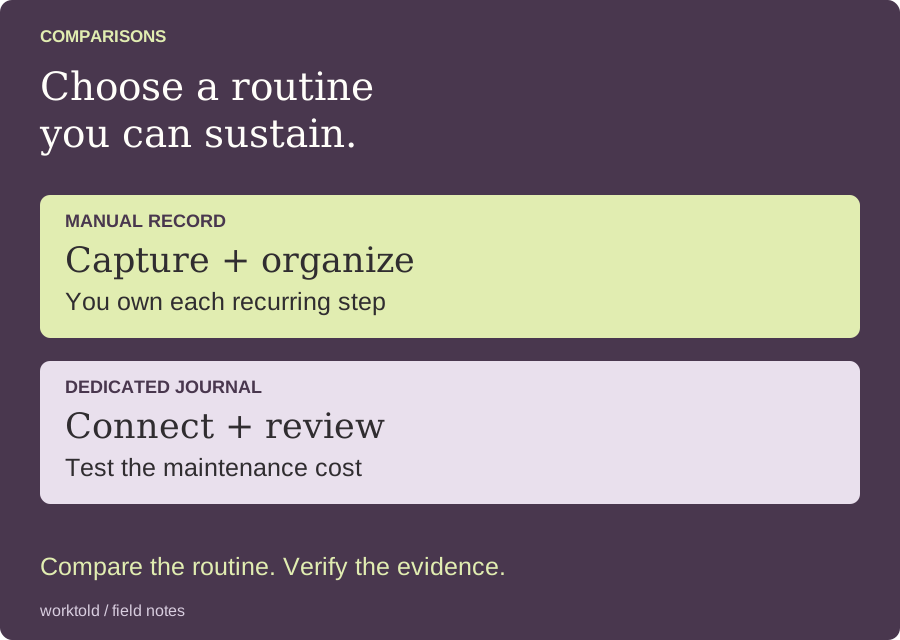
That retrieval check matters more than the first impressive output. The maintenance cost appears when the ladder changes, a source link disappears, two sessions describe the same project, or you correct an attribution. Decide who will handle those cases before you rely on the system for a review cycle.
When Claude is the better choice
Use a custom Claude workflow when you already have approved access, enjoy controlling the structure, and can keep a small review habit. It can also be sensible for an urgent self-review: you need an evidence-backed draft this week, while Worktold’s MVP is planned for later. Do not delay a manager conversation while waiting for a product.
Evaluate Worktold when recurring collection and organization are the parts you keep abandoning. Its intended focus is a continuous view of work against your ladder. Whether it reduces your effort is something to test with your own sources once available, not a benefit this article can prove from the demo.
Your decision checklist
- Identify the approved sources you can actually use.
- Write down where accepted records will live and who controls access.
- Try one investigation, one shipped change, and one collaboration example.
- Correct a mistake and confirm the correction survives the next draft.
- Check whether you can retrieve a record without remembering its exact wording.
- Ask what happens to access and retained records when you change jobs.
The founder’s product brief includes linking a personal email for continuity. We have not verified that behavior in a released product. Account continuity also does not grant permission to retain employer material. Treat the exact portability behavior as a question to resolve, not a reason to move company files.
Next, compare ChatGPT workflows or use the AI-assisted work record example to test your current system.
Written for Worktold using public sources and original illustrative examples. Product research checked November 10, 2026. Read our editorial approach and comparison limits.