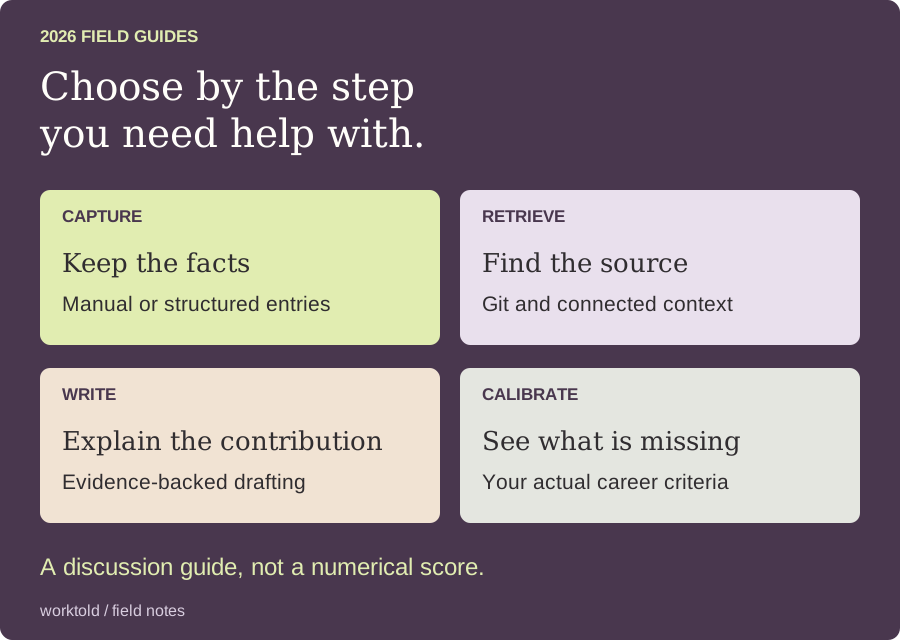
BragBook is a relevant option if you want to capture accomplishments and turn them into career content. Worktold is being built around connecting the context behind work and organizing evidence against a company career ladder. Choose by the part of the process you struggle to maintain, then test the specific behavior you need.
“I need a brag document” can mean several things. You might need a place to log a win, a way to import completed work, help drafting a self-review, or a view of the evidence missing from a promotion case. Those needs overlap, but they are not interchangeable. A useful comparison starts with one recent moment when your current system failed you.
This article compares Worktold with BragBook at bragbook.io. Other products use similar names. Public sources were reviewed November 10, 2026. We publish Worktold and have a commercial interest; we have not conducted a controlled hands-on benchmark.
What BragBook publicly offers
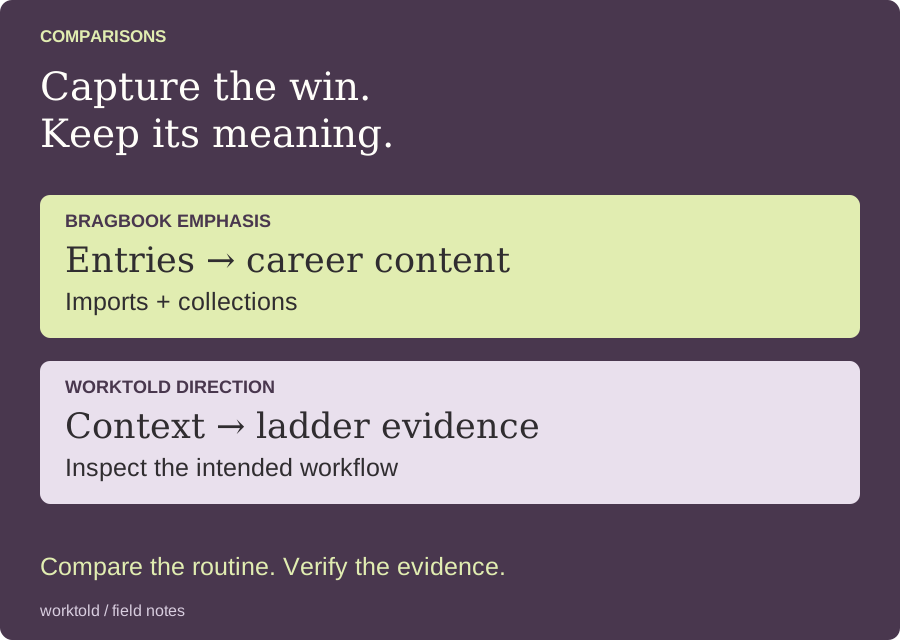
BragBook’s website describes quick-note capture, AI-assisted career writing, collections, and CSV export. It also advertises importing completed work from GitHub, Jira, Linear, Asana, and Dovetail. It would be wrong to describe it as purely manual or to imply that integrations alone distinguish Worktold.
The more useful question is what the resulting record explains. Does it preserve the source and your particular role? Can it distinguish a completed task from a measured outcome? Does the organization of the record match how you prepare for conversations? Inspect those behaviors directly rather than assuming that a feature label answers them.
Compare the job you want done
Scroll sideways to see all columns.
| Need | BragBook | Worktold |
|---|---|---|
| Record accomplishments | Quick notes and advertised completed-work imports | Intended journal of selected context, decisions, contributions, and outcomes |
| Prepare career writing | Advertised summaries, reviews, and other career content | Sample review and packet outputs in the demo |
| Organize evidence | Collections are documented | A timeline and career-ladder view are demonstrated |
| Understand an investigation | Test whether your inputs preserve the reasoning you need | The demo illustrates an investigation across documents, discussion, and AI |
| Use the product now | Assess the current offering and account requirements directly | Demo and guide available; MVP planned for Nov 26–29, 2026 |
An accomplishment is a starting point
Imagine that you improved an onboarding flow. Your first entry says, “Helped reduce onboarding failures.” That is worth capturing, but it leaves several questions. Which failures? What did you change? Who else worked on it? What measurement supports the reduction? What decision required your judgment?
A stronger record might say: “I traced a failure affecting users who resumed setup after a network interruption. I proposed preserving the pending state, paired with another engineer on the implementation, and added recovery tests. The release is live; the team is still collecting post-release failure data.” This is a fictional example. It illustrates how a modest, accurate entry can be more useful than a large unsupported claim.
Either approach should help you keep that distinction. A tool can make capture easier and writing clearer, but you still need to know whether a claimed result happened. If you only have a completed ticket, preserve it as evidence of completion and add the outcome later.
Run a three-record trial
Choose three kinds of work: a delivered change, an investigation that did not ship, and a contribution to another person’s project. Use approved evidence for each. You are testing whether the system fits your work, not whether it can make an ideal example look polished.
For the delivered change, inspect the state and metric. For the investigation, see whether the result remains valuable without becoming a fictional launch. For the collaboration example, check whether the system preserves the other person’s ownership while making your role clear. These cases expose different weaknesses in a record.
Next, ask for a summary against one actual company criterion. If you need a workaround, record it. If you must manually add a source or amend attribution, include that maintenance in your evaluation. A small amount of manual review may be perfectly acceptable; the point is to know what you are signing up to do.
Check portability separately from presentation
A shareable page, an export, and continued account access solve different problems. Ask which fields and attachments an export contains, whether source links still work, and how you will find an old record after switching roles. Do not assume a polished output is a complete backup.
The founder’s Worktold brief includes continuity through a linked personal email. The public source we inspected does not verify that released behavior. It also does not establish broad Google Workspace or GitLab coverage. Treat those as product questions to confirm. For any service, keep employer information in approved locations and retain only material you are permitted to keep.
Choose based on your current bottleneck
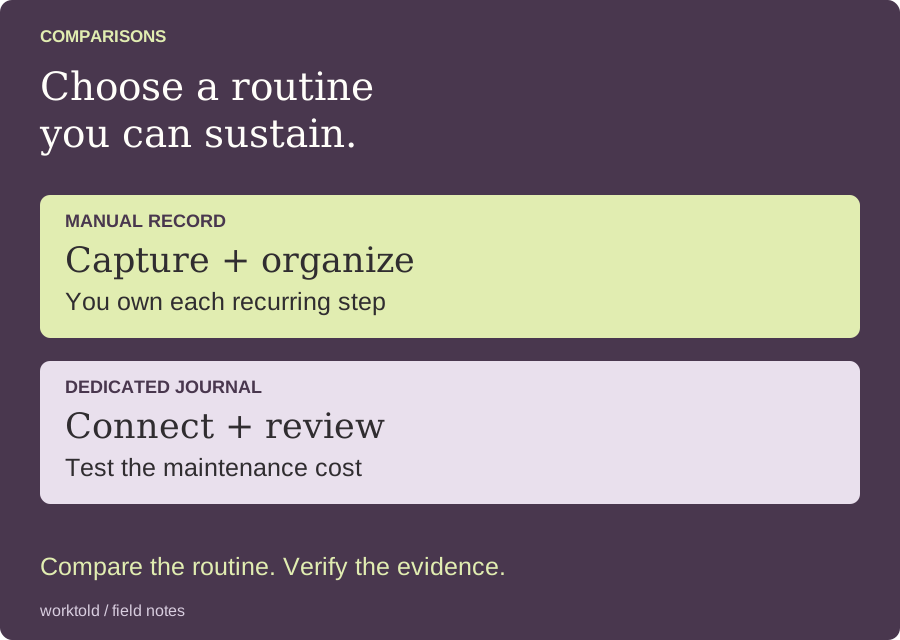
If you already know what you achieved and mainly need consistent capture and reusable career writing, BragBook deserves a place on your shortlist. If the missing piece is understanding how scattered work supports your next-level expectations, inspect Worktold’s demo and compare its intended workflow with your current process.
You may discover that the real missing piece is a conversation with your manager. A collection labeled “leadership” does not establish what leadership means at your company. Before changing tools, bring two records to a meeting and ask which expectation they support and what would make the evidence stronger.
- Confirm the exact product and domain you are comparing.
- Test imports against your actual approved tools.
- Include non-shipping work and shared ownership in the trial.
- Check the contents of a real export.
- Compare the corrections needed, not just the first draft.
- Ask your manager whether the resulting evidence helps.
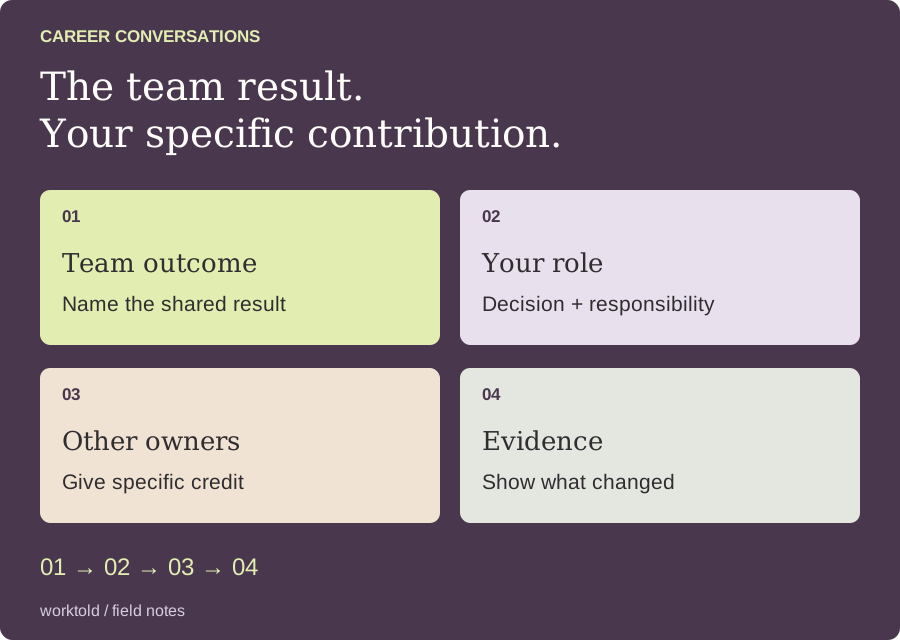
Read how to describe individual contributions fairly, or compare the manual document approach. For a wider shortlist, see brag-document tools for 2026.
Written for Worktold using public sources and original illustrative examples. Product research checked November 10, 2026. Read our editorial approach and comparison limits.