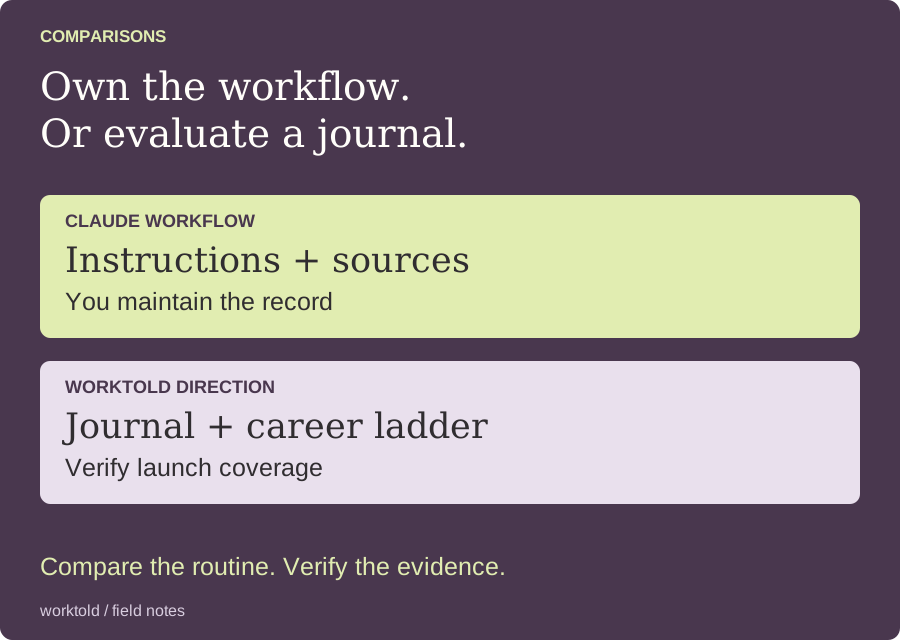
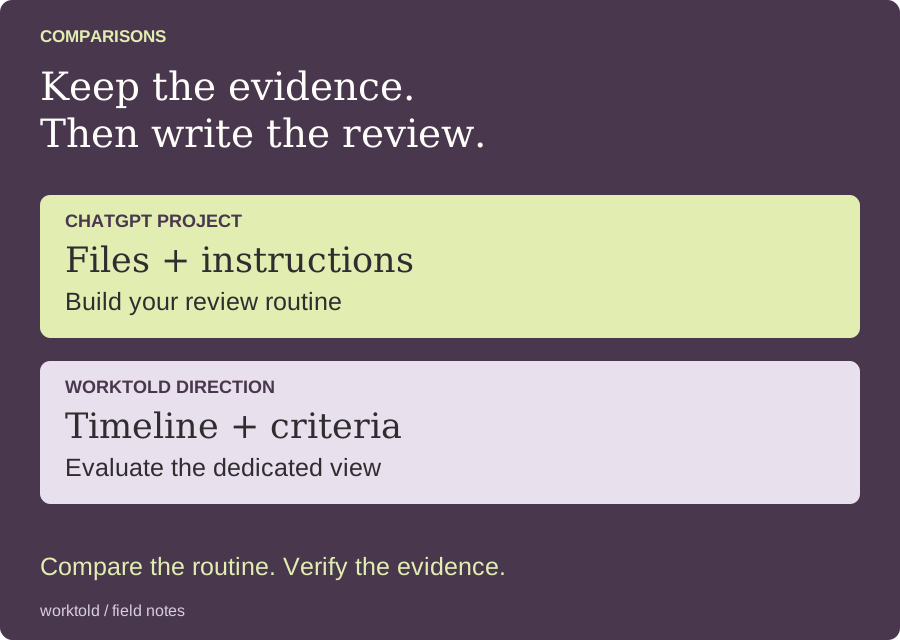
Use a ChatGPT project when you want to organize evidence and instructions around a review, explore your story, and draft with a general assistant. Evaluate Worktold if you want a dedicated journal organized around your company’s career ladder. The distinction is the workflow you maintain, not whether an assistant can remember context or use connected sources.
A performance review often starts with the wrong request: “Make my work sound more senior.” A better starting point is “Which claims can I support, which expectations do they relate to, and what evidence am I missing?” The first prompt invites stronger language. The second creates a basis for a useful career conversation.
This comparison uses public documentation and the Worktold demo, checked November 10, 2026. Worktold publishes this article and benefits commercially from interest in its product. We have not benchmarked output quality or tested every account configuration.
A fair picture of ChatGPT
OpenAI’s Projects and chats documentation describes projects that organize related chats, files, instructions, and sources. A career workflow can therefore be more durable than repeatedly pasting notes into unrelated chats. What ChatGPT can access depends on the sources and tools available in your setup.
For this comparison, “ChatGPT workflow” means a project containing an approved career framework, a structured set of work records, and explicit drafting instructions. It does not mean that ChatGPT automatically knows everything you did. Nor does it mean that you must manually paste every document: connected sources may be available. Confirm their actual coverage before relying on them.
Project workspace or dedicated journal?
Scroll sideways to see all columns.
| Question | ChatGPT project workflow | Worktold |
|---|---|---|
| What defines the record? | The structure and instructions you choose | The journal structure illustrated in the product demo |
| What supplies the context? | Uploaded files and sources available to the project | Selected cross-tool context in the intended product; exact launch coverage needs confirmation |
| Who maintains accuracy? | You review drafts and maintain accepted evidence | You still review evidence and proposed records |
| How is progress assessed? | You ask for an analysis against supplied criteria | The demo provides a ladder view of supporting and missing evidence |
| What can be evaluated today? | Your own approved ChatGPT setup | A fictional-data demo and the free guide; MVP planned for Nov 26–29, 2026 |
Build a review project that stays useful
Create three distinct inputs. First, keep the exact version of your company’s framework, including the current and target levels. Second, maintain accepted records with source references. Third, keep open questions: outcomes still being measured, attribution to confirm, and feedback from your manager. Combining all three into an undifferentiated transcript makes uncertain statements look like settled facts.
Ask the assistant to draft from accepted records only. Require it to list unsupported claims separately. When it proposes a ladder mapping, ask it to cite the specific criterion and explain why the evidence fits. A keyword overlap is not enough: “mentored a colleague once” may not establish sustained team development.
Use an instruction such as: “Preserve the strength of the evidence. Do not improve a claim by changing its meaning. If I investigated a problem, do not say I fixed it. If a team delivered a result, identify my role without assigning me the whole outcome.” These instructions improve the review process; they do not replace checking the answer.
An example where wording changes the claim
Suppose your input says: “Reviewed a migration plan, raised rollback concerns, helped run a staging test. Production rollout is next month.” A confident draft might turn that into “Led a successful migration with zero downtime.” That sentence changes your role, the completion state, and the outcome.
A defensible version is: “I identified a rollback gap during migration review and helped validate the revised procedure in staging. The production rollout is scheduled for next month.” It can support technical judgment and collaboration. The production result belongs in a later update, with its own evidence.
Run this exercise in any assistant you use. Keep the original input beside the draft and mark every new factual assertion. If the draft adds a number, a completion state, or a leadership claim, find its source or remove it. An elegant summary is useful only after this check.
Where the choice becomes practical
ChatGPT can be the right choice when your evidence is already organized and you mainly need help finding themes, preparing questions, or editing a self-review. The cost of introducing another product may exceed the benefit. A simple file plus a thoughtful conversation can be enough.
Worktold’s intended advantage is a dedicated home for the recurring evidence work: connecting selected context, reviewing records, and seeing how the record supports a ladder. The demo is a way to inspect that proposed experience. It is not proof of complete integrations, automatic synchronization, or reliable promotion predictions.
The useful buying question is: “What part of the weekly routine will I still need to own?” Compare how you collect source material, resolve duplicates, amend records, find gaps, and prepare a shareable summary. Test the least tidy example you have, rather than the project that already has a perfect launch document.
Before choosing either route
- Check that your employer permits the sources and destination.
- Keep an accepted evidence record outside a one-off generated draft.
- Label whether each item was proposed, tested, merged, deployed, or measured.
- Preserve the distinction between your role and the team result.
- Review a disputed mapping with your manager.
- Test retrieval and corrections after several sessions, not just the first.
For an immediate review deadline, start with the self-review guide. For a recurring capture routine, compare manual tracking and the Claude skill approach. The best system is the one that preserves truthful evidence at a cost you can sustain.
Written for Worktold using public sources and original illustrative examples. Product research checked November 10, 2026. Read our editorial approach and comparison limits.