A useful software-engineer self-review explains a few meaningful contributions with evidence, then identifies what you learned and what should change next. Organize it around outcomes and scope, not a chronological inventory of tickets. Use the company’s review prompts and framework as the final structure.
When the form opens, the temptation is to recover everything you did and fit it all into the page. That usually produces a long document with no clear argument. The reader needs to understand which work mattered, what your role was, and how confidently the result can be assessed.
The examples in this article are fictional. They show how to write with appropriate precision; their numbers and situations are not Worktold customer results. Adapt the structure to your own evidence rather than copying the accomplishments.
Select the evidence before drafting
Start with a work log, project documents, approved source links, and feedback you received. Group related records into a few themes. Then choose the strongest examples for the review period. A theme should express something you contributed, such as improving release safety or helping other teams adopt a platform, rather than a broad label like “excellence.”
Julia Evans’s brag-document essay is a useful starting point for collecting work throughout the year. Once you have the material, selection becomes the important step. More entries do not automatically produce a clearer review.
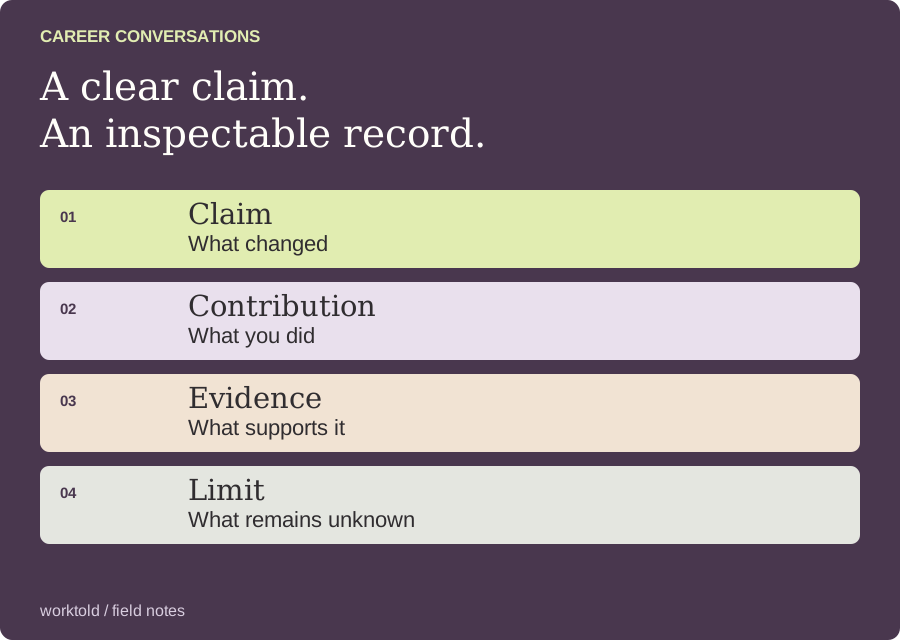
Use a claim, contribution, evidence, and limit
Scroll sideways to see all columns.
| Part | What to include |
|---|---|
| Claim | The meaningful change or completed work |
| Contribution | Your decision, ownership, or specific action |
| Evidence | The artifact or observation supporting the claim |
| Limit | What is still unknown, pending, or shared with others |
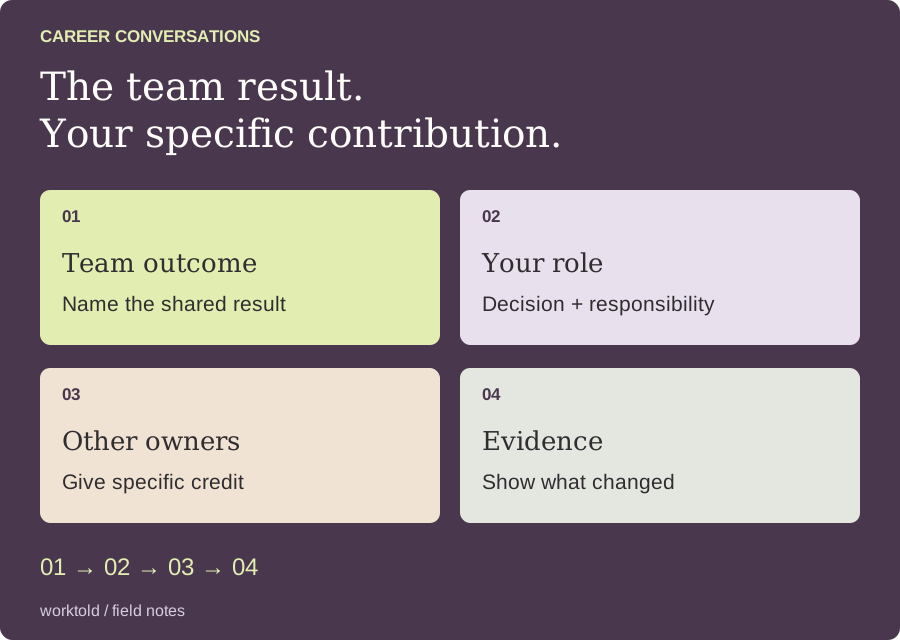
The limit is not an apology. It tells the reader exactly what they can conclude. If a result is still being measured, say so. If several people produced the outcome, explain your contribution within that shared result.
Example: a delivered reliability change
Weak: “I fixed lots of bugs and improved reliability.”
I led the investigation into duplicate retry handling in the payment service and proposed an idempotency check at the service boundary. I implemented the check with Maya and added regression coverage for the reproduced failure. The change was released on September 12. The incident dashboard recorded no recurrence of that failure signature during the following four weeks; this observation does not establish that all retry failures are resolved.
The improved version names the problem, judgment, collaboration, release state, observation period, and boundary. In a real review, link the investigation, change, deployment, and dashboard. If any of those sources is missing, narrow the statement to what you can support.
Example: helping another team deliver
Weak: “I mentored people and showed leadership.”
I helped the client team adopt the new authentication library by documenting migration pitfalls and running two design reviews. The client engineers owned implementation. Their first rollout used the migration checklist, and their lead confirmed that it caught an unsupported token-refresh path before release. I will collect feedback from the next adopting team before claiming the checklist works broadly.
This example keeps the other team’s ownership intact. It identifies a concrete contribution and a source for the result. It also avoids treating one successful adoption as proof of organization-wide impact. For more on attribution, see making your contribution visible.
Example: work that did not ship
Weak: “The prototype was canceled, so there is nothing to report.”
I evaluated whether replica reads could satisfy the immediate-consistency requirement. After identifying a mismatch between the proposed cache change and the data source, I built a bounded test and documented the failure. The team used that evidence to stop the replica-only approach and reconsider primary routing. No production change or financial saving is claimed.
The completed work is an investigation and decision support. It can be valuable without being relabeled as a launch. Explain who used the result and what decision changed. If nobody acted on the investigation, state that too.
Write the growth section with the same precision
A growth area should describe a behavior and its consequence, followed by a specific adjustment. “I need to communicate better” is difficult to assess. “I involved the client team after the API shape was largely settled, which caused rework; next quarter I will include their constraints before the first design review” is actionable.
Avoid using the growth section only for disguised strengths. Also avoid turning it into an inventory of personal failings. Select one or two changes that matter to the work you will do next. Name the support or opportunity you need from your manager.
Edit for the reviewer’s questions
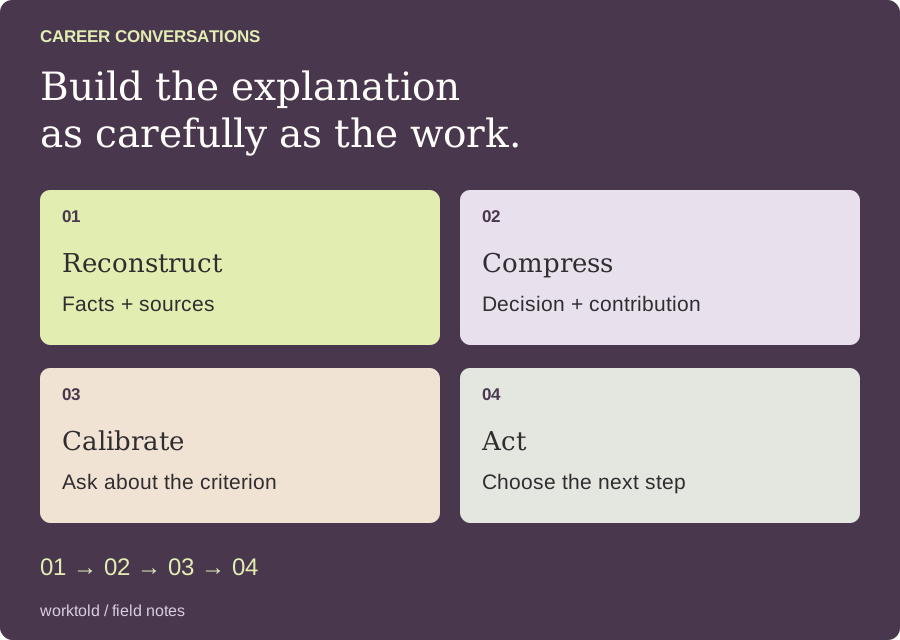
Read each paragraph as someone who did not attend the meetings. Is the problem understandable? Can you tell what the engineer actually did? Is the result supported? Is the scope clear? If the answer depends on knowing an internal acronym, add one short explanation.
Then remove repeated claims. Several tickets may support one contribution. Combine them and keep the best sources. Preserve detail in linked evidence so the review stays readable without becoming unverifiable.
- Every major claim has a source or a clearly labeled personal observation.
- Your role is distinct from the team outcome.
- Numbers include a baseline and time window.
- Proposed work is not described as completed.
- Each theme connects to the review’s actual expectations.
- The growth section leads to a concrete next action.
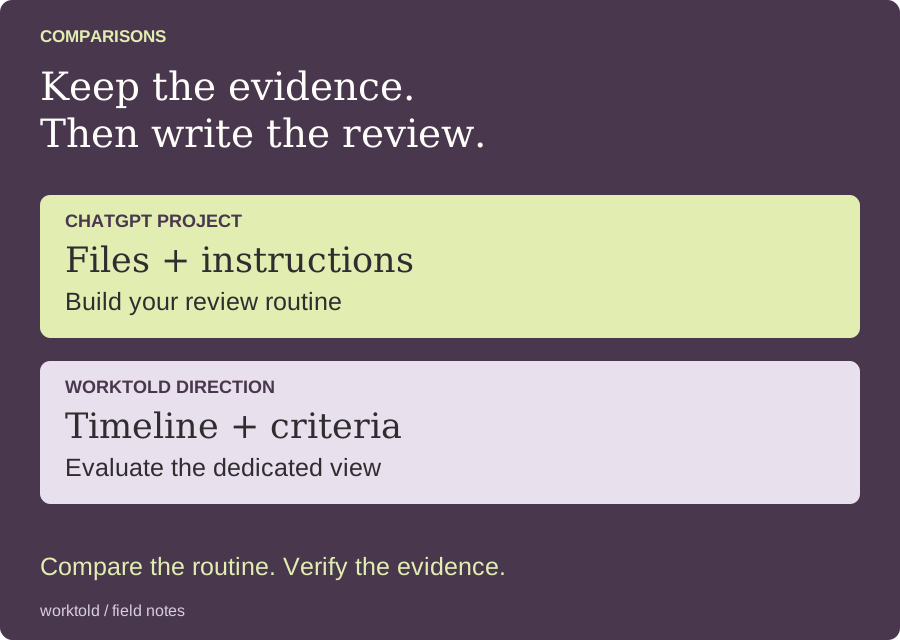
If you use an assistant to draft, ask it to flag unsupported statements rather than strengthen them. Our ChatGPT workflow comparison explains how to separate accepted evidence from drafts. For the source record itself, start with the free guide or inspect Worktold’s fictional-data demo.
Written for Worktold using public sources and original illustrative examples. Product research checked November 10, 2026. Read our editorial approach and comparison limits.