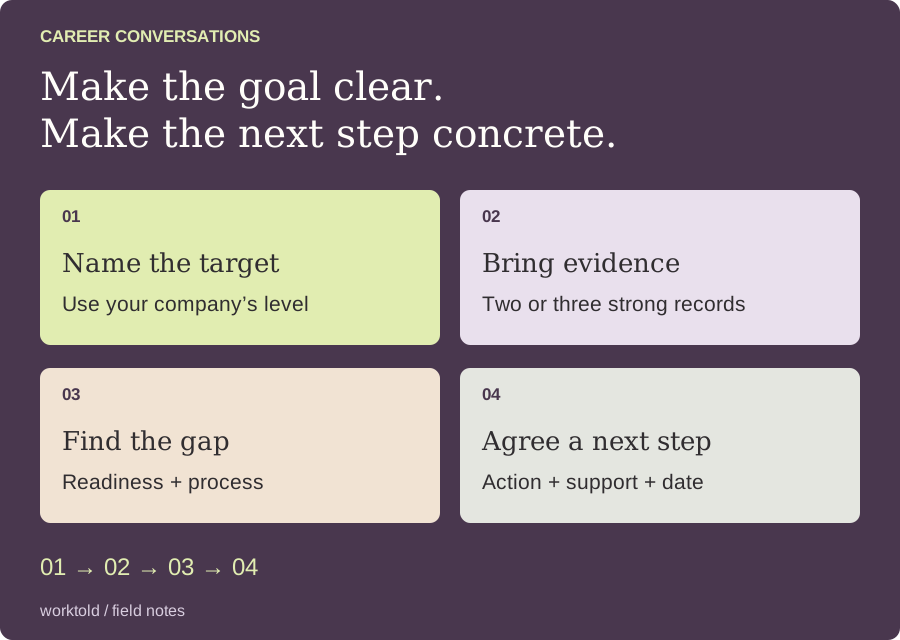
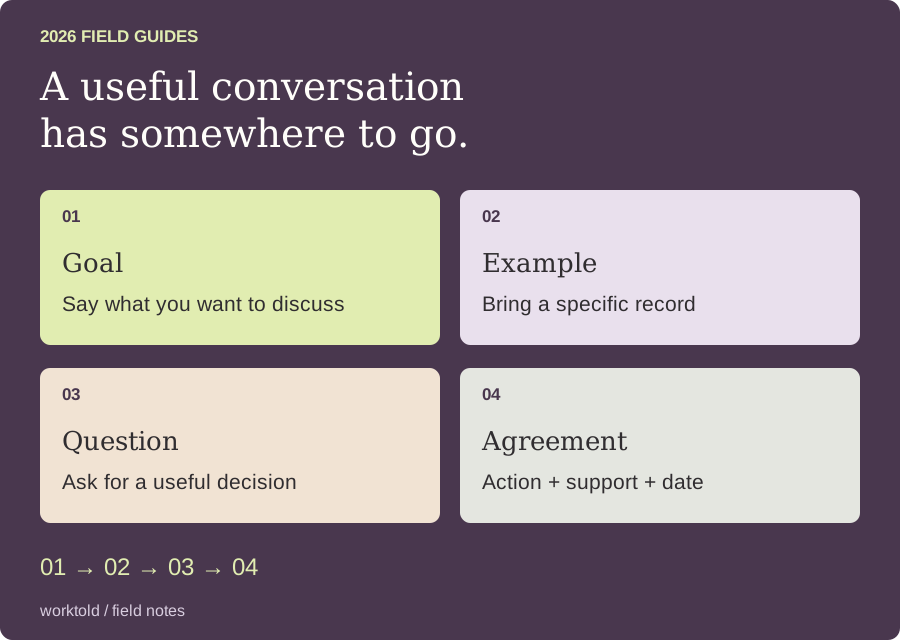
Being good at engineering and being good at career conversations require different practice. Engineering work produces changes in a system. A career conversation makes your judgment, contribution, and scope understandable to someone deciding what responsibility you should take next. You need both the work and an accurate explanation of it.
You can be the person who spots the dangerous assumption, unblocks a migration, or makes a fragile system easier to operate—and still struggle to answer “What impact did you have this quarter?” That does not erase the work. It means the explanation has not been built yet.
Aida Issayeva’s reflection on early-career mistakes treats persuasion as part of getting support for ideas. Her post about downplaying contributions makes a related point: sharing credit should not make your own role disappear. This article turns those ideas into a repeatable practice.
You are producing a second deliverable
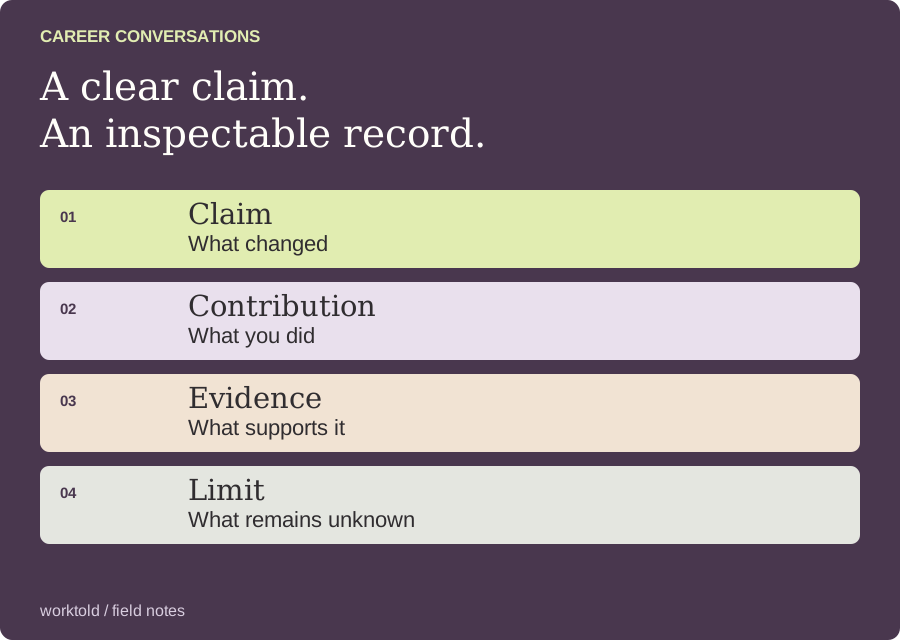
The first deliverable may be code, a design, a decision, or an operational improvement. The second is an explanation another person can evaluate. It should answer four questions: what problem mattered, what judgment you exercised, what you contributed, and what changed.
The audience changes the level of detail. A teammate may need implementation choices. Your manager may need your role and what remains uncertain. A reviewer outside the team needs enough context to understand why the work mattered and how it demonstrates the company’s expectations. None of those audiences needs a transcript of everything you did.
Translate without inflating
Scroll sideways to see all columns.
| Version | What the listener learns | What to improve |
|---|---|---|
| “I worked on caching.” | The topic | Add the constraint, decision, and result |
| “I transformed reliability.” | A large claim with no basis | Replace the adjective with verifiable facts |
| “I found that cache bypass still read from a lagging replica, tested it, and documented why the proposal failed the consistency requirement.” | A specific contribution and bounded result | Add the source and discuss the relevant criterion |
The third version does not claim a launch or a financial saving. It makes the engineering judgment visible. A reviewer can now ask useful questions about the test, the constraint, and your role. Accurate specificity is more persuasive than a stronger adjective.
Practice the conversation in three passes
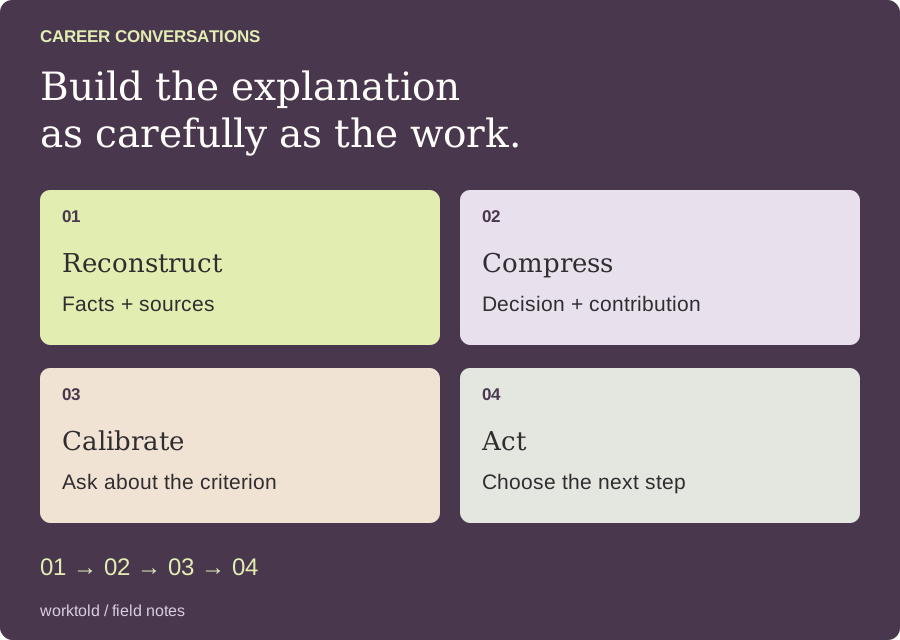
Pass one: reconstruct. Write the story for yourself while the details are fresh. Use rough language. Link the evidence and label uncertainty. If several people contributed, name what each did. Do this before trying to make the prose impressive.
Pass two: compress. Reduce the story to a short explanation a colleague outside the project can follow. Keep the decision and result. Remove implementation detail that does not explain either. If you cannot compress it, you may not yet know which part of the work matters for the conversation.
Pass three: ask. End with a question that changes the next step: “Does this demonstrate the scope expected at my target level?” or “What evidence would make this stronger?” A career conversation should produce information you can act on, not just a favorable reaction.
Try this with one record before every other one-on-one. You are practicing the ability to explain and calibrate work. There is no need to turn every meeting into a promotion pitch.
Make feedback precise enough to use
If your manager says “You need more visibility,” ask what decision currently lacks information. Does another team need to know about your design? Does the promotion reviewer need a clearer account of your role? Does your manager need earlier notice of risks? Each answer leads to a different action.
If the answer is “Be more strategic,” ask for an example of strategic work at the target level and the difference from your current work. You might need to choose a broader problem, bring alternatives before committing to a solution, or influence a decision beyond your team. Sending more status updates would not necessarily address any of those gaps.
Write the interpretation down and confirm it. Otherwise, you can spend a quarter practicing the wrong behavior while both of you believe the expectation was clear.
Communication cannot manufacture scope
A careful narrative can reveal work that was overlooked. It cannot turn a team-local change into organization-wide influence. If the evidence does not support the expected scope, the next move is to change the work or secure an opportunity to demonstrate it.
It also cannot remove every organizational constraint. Promotion decisions may depend on role availability, calibration, and timing. Ask about those explicitly instead of assuming better writing will solve them. Distinguish a missing evidence problem from a missing opportunity problem.
A fifteen-minute practice exercise
Choose one contribution from the week. Spend five minutes writing the facts and sources. Spend five minutes producing a short explanation. Use the remaining five minutes to identify one claim you cannot yet support and one question for your manager. The time box is a suggested exercise, not a measured productivity claim.
- Can someone outside the project understand the problem?
- Is your decision different from a list of tasks?
- Have you described your role without erasing collaborators?
- Does the outcome match the evidence?
- Is the ladder mapping tentative where it should be?
- Will the conversation produce a next action?
A journal can make these facts easier to retrieve. Worktold’s demo illustrates that connection between work records and career criteria, while the free manual guide gives you a way to start now. For the next conversation, use the promotion discussion guide or seven practical conversation templates.
Written for Worktold using public sources and original illustrative examples. Product research checked November 10, 2026. Read our editorial approach and comparison limits.