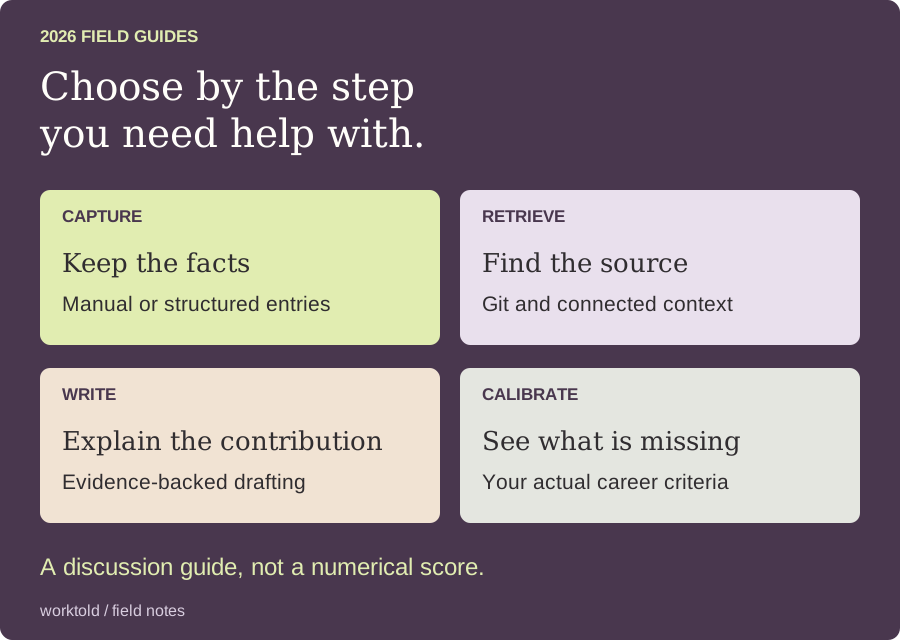
The best brag-document tool in 2026 depends on what you need help doing: capturing work, recovering repository history, drafting a review, or connecting evidence to a career ladder. This shortlist includes seven approaches with different strengths. It is not a universal ranking, and Worktold is included as an early-access product to evaluate rather than a proven winner.
A tool can produce an attractive document while leaving your main problem unresolved. If you forget the context behind decisions, a writing assistant alone may not fix the capture habit. If your evidence is already organized, a new tracker may add more maintenance than value.
We publish Worktold and have a commercial interest in this comparison. We reviewed public product documentation on November 10, 2026. We did not run a hands-on benchmark, purchase every plan, or measure time savings. We exclude numerical ratings and unverified pricing because they would suggest precision this research does not support.
The shortlist by use case
Scroll sideways to see all columns.
| Option | Consider it for | What to test |
|---|---|---|
| Manual document or spreadsheet | A simple record under your control | Whether you keep the weekly habit |
| Claude with a custom workflow | Reusable evidence-processing instructions | Source coverage, corrections, and where accepted records live |
| ChatGPT project | Organized review context and drafting | Whether the project preserves a clear evidence trail |
| BragDoc | Git-derived achievements and career themes | How extraction represents your actual role and outcome |
| BragBook at bragbook.io | Accomplishment capture and career writing | Imports, attribution, and useful exported records |
| Pull Tally | Monthly retrieval of merged GitHub PRs | Repository coverage and dependence on current source access |
| Worktold | Evaluating a dedicated cross-tool journal and ladder workflow | Released behavior when available; today’s demo uses fictional data |
1. A manual document: a strong starting point
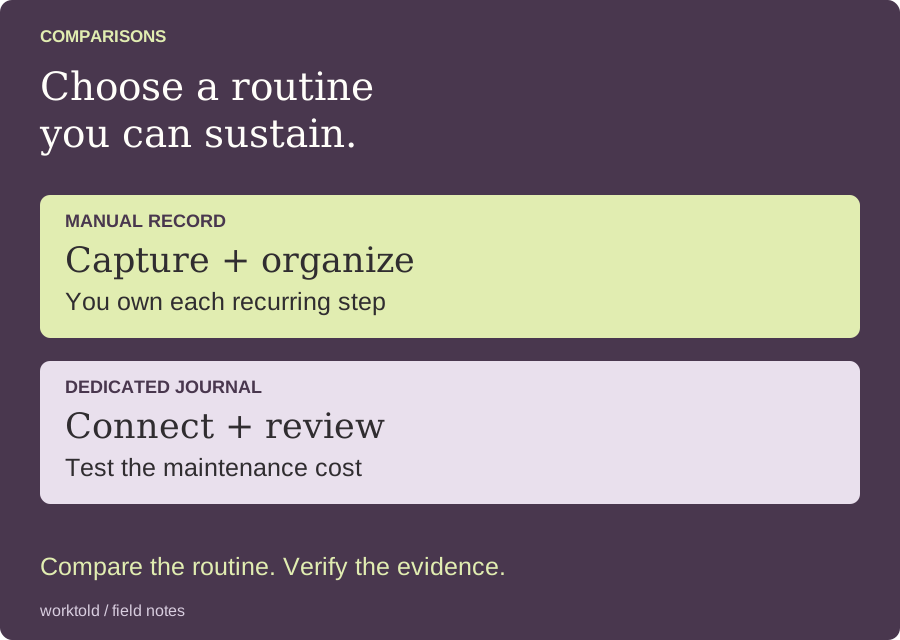
Use an approved document, spreadsheet, or local file if you want direct control and a small setup. Capture the situation, decision, contribution, outcome, and source. The main limitation is the recurring effort you own. If the habit works, there is no need to replace it just because more specialized tools exist.
Start with the free manual guide. Our manual-tracking comparison includes a two-week exercise for measuring your own maintenance cost.
2. Claude: for a workflow you can customize
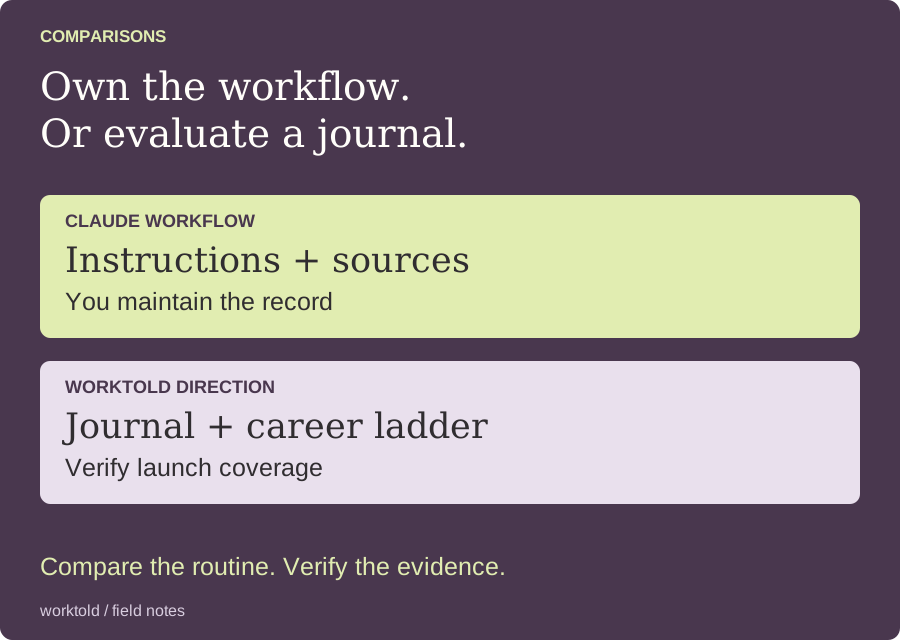
Anthropic documents custom skills and connectors. That makes a configured workflow a legitimate alternative to a dedicated career product. You still need to decide how accepted records are stored, corrected, and reused.
Choose this direction when maintaining the instructions and record structure is acceptable to you. Read the full Claude comparison for a concrete test case.
3. ChatGPT: for review context and drafting
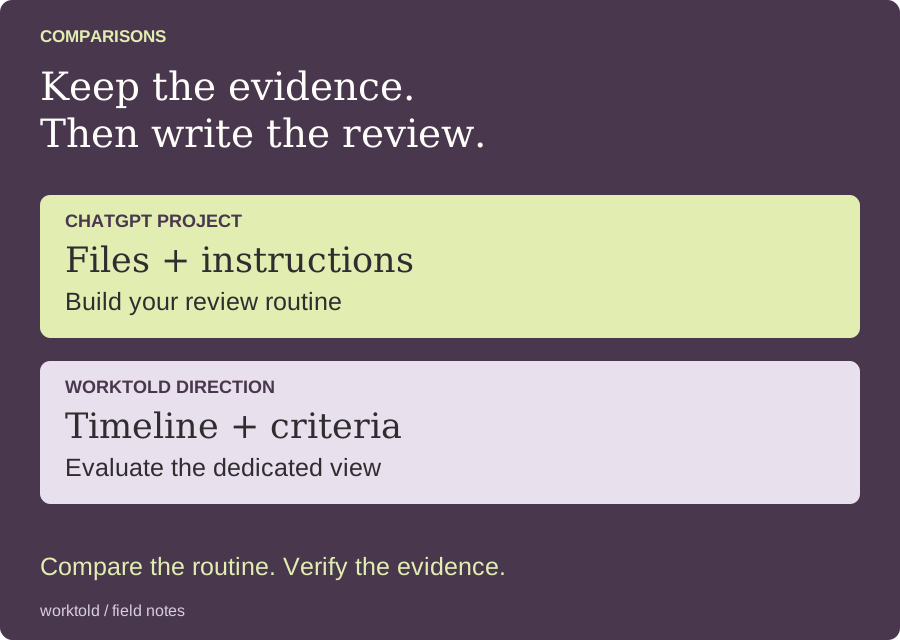
OpenAI’s project documentation describes shared files, instructions, and sources across related chats. A project can be a useful home for a review workflow. Keep accepted evidence distinct from generated prose so a draft does not become the source of its own claims.
This is especially worth trying when you already have the records and need help finding themes or preparing questions. The ChatGPT comparison includes a practical setup.
4. BragDoc: for a Git-centered record
BragDoc documents achievement extraction and career documents, with Workstreams for organizing themes. Evaluate it with shared-ownership work and an outcome that is still pending. A useful extraction should preserve those distinctions.
Read the BragDoc comparison if repository history is the evidence you most often struggle to recover.
5. BragBook: for capture and career content
BragBook advertises notes, career-writing outputs, completed-work imports, collections, and CSV export. It is not just a blank manual journal. Test the sources you use and inspect what a real export retains before committing your whole record.
Use the BragBook comparison to evaluate a shipped change, an investigation, and a collaboration example.
6. Pull Tally: for finding merged PRs
Pull Tally is an invite-only beta focused on monthly merged-PR history. Its site explains that available history depends on source access and is not a permanent archive. That may fit a retrieval need well, while leaving interpretation to your existing journal.
Read the Pull Tally comparison to distinguish finding a change from explaining its career relevance.
7. Worktold: a dedicated workflow to evaluate
Worktold’s live demo connects a fictional work record to career criteria. The intended product brings selected context across work tools into a journal. As of this review, the site plans MVP early access for November 26–29, 2026. Broad connector coverage and personal-email continuity from the founder’s brief are not verified released capabilities.
Explore the demo if that recurring workflow is what you need. Do not treat a demo as evidence of production reliability, complete imports, or a guaranteed promotion outcome.
Choose with one small trial
Select an ordinary week and three approved examples. Include a delivered change, non-shipping work, and a contribution to someone else’s project. Compare coverage, source traceability, correction effort, and retrieval later. Use your own results to judge the tradeoff.
- Identify the recurring step that currently fails.
- Confirm approved sources and destination.
- Check factual claims against original evidence.
- Inspect corrections and exports.
- Ask your manager whether the record helps.
- Keep the simplest system that meets the need.
If the evidence is already collected, your next step may be practicing the conversation, not shopping for another tool.
Written for Worktold using public sources and original illustrative examples. Product research checked November 10, 2026. Read our editorial approach and comparison limits.